

Simulator Usage
- SDK
- IDE
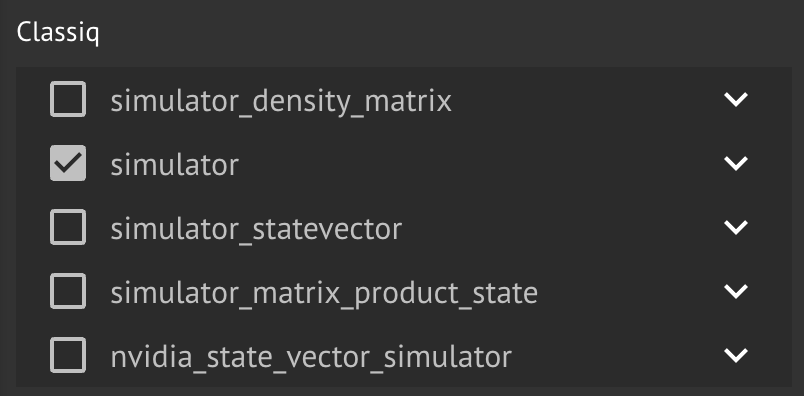
-
simulator: A general-purpose quantum simulator capable of handling circuits with up to 25 qubits. -
simulator_statevector: Returns the full state vector, including phase information of the output state produced by the quantum circuit. Due to the exponential growth of the state vector, this simulator is suitable only for circuits with up to 18 qubits. -
simulator_density_matrix: Uses density matrices to simulate open quantum circuits and supports simulations for circuits containing up to 25 qubits. -
simulator_matrix_product_state: Efficiently simulates quantum circuits of up to 25 qubits, especially suited for circuits exhibiting low entanglement.
ClassiqSimulatorBackendNames.
Custom noise models
Classiq simulators support user-defined gate and readout noise throughClassiqSimulatorNoiseSpecification. This is separate from preset device noise
(noise_model on ClassiqBackendPreferences). See
Custom noise models on Classiq simulators for channel types,
validation rules, and code examples.
Nvidia Simulator Usage
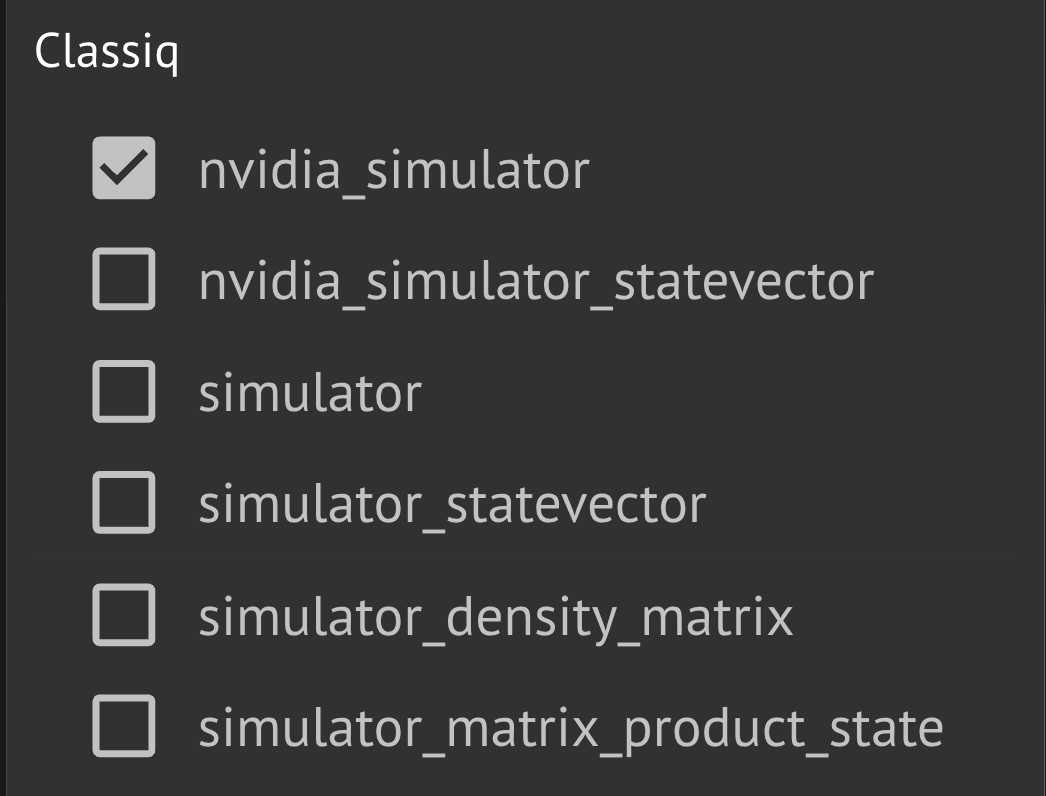
Execution on Nvidia simulators requires specific license permissions. Before first use, contact Classiq support. Classiq supports two types of Nvidia simulators, with the same inputs and outputs but different underlying infrastructure, capable of simulating circuits with up to 29 qubits:- The backends
ClassiqNvidiaBackendNames.SIMULATORandClassiqNvidiaBackendNames.SIMULATOR_STATEVECTORare better suited when multiple circuits need to be executed in sequence. - The backends
ClassiqNvidiaBackendNames.BRAKET_NVIDIA_SIMULATORandClassiqNvidiaBackendNames.BRAKET_NVIDIA_SIMULATOR_STATEVECTORare executed using Amazon Braket’s infrastructure, and provide faster execution for single circuits. Credentials for AWS are not needed.
ClassiqNvidiaBackendNames.SIMULATOR_STATEVECTOR and ClassiqNvidiaBackendNames.braket_nvidia_simulator_statevector return the state vector at the end of the circuit’s execution (analogous to the
above simulator_statevector).
Precision: Nvidia and Braket Nvidia simulators use double precision (float64) by default. Set use_single_precision=True in ClassiqBackendPreferences to use single precision (float32), which can be faster and use less memory at the cost of numerical precision.
- SDK
- IDE
The number of execution requests to the NVIDIA simulator may be limited.
If you encounter any problem, contact
Classiq support.
DGX Statevector Simulator
Classiq offers a GPU-accelerated statevector simulator running on an NVIDIA DGX system. It is designed for large circuits, supporting up to 35 qubits, making it well suited for state-vector simulations that exceed the capacity of the standard Classiq simulators. Like the other GPU simulators, the DGX simulator requires specific license permissions. Before first use, contact Classiq support. The DGX simulator supports both execution modes:- Sampling: returns measurement counts for a given number of shots.
- Statevector: returns the full output state vector. Because the state vector grows exponentially with the number of qubits, large statevector requests can be very large; filtering the returned registers is recommended.
backend="classiq/dgx_simulator" to your execution call. For example:
The number of execution requests to the DGX simulator may be limited, and large circuits can take a long time to run. If you encounter any problem, contact Classiq support.
Supported Backends
Included simulators:- “nvidia_simulator_statevector”
- “simulator”
- “simulator_statevector”
- “simulator_density_matrix”
- “nvidia_simulator”
- “braket_nvidia_simulator”
- “simulator_matrix_product_state”
- “braket_nvidia_simulator_statevector”
- “dgx_simulator”