

Upgrade Instructions
- Python SDK
- The IDE upgrades automatically.
Releases by Version
2026-10-25
Enhancements
- SDK: Added
get_quantum_program(program_id), which fetches an already-synthesized quantum program by its ID. - Execution: Added
provider_sessiontoExecutionSessionandvariational_minimize(defaultTrue) so users can opt out of provider-side runtime sessions. Standalone one-shot helpers (sample,observe, andcalculate_state_vector) never open a provider session.
Bug Fixes
-
Execution:
sampleandobserveprint the Studio job page for the organization site. The job still runs on the Classiq API. -
Synthesis: Fixed internal errors for a quantum array indexed by a value that is not an integer: a classical array (
q[idx]for aCArray[CInt]parameteridx), a real number (q[0.5]or aCRealargument), a struct, or a quantum variable. Synthesis now reports that array indices must be integers, and also rejects aCBoolindex, which was previously read as 0 or 1. To pass several elements, use[q[idx[i]] for i in range(idx.len)]; to index with a real-valued expression, round it withfloor, as inq[floor(log(x, 2))].
Interface Changes
add_ripple_carry_cdkmandadd_ripple_carry_shallow: Theauxargument was removed. Call them asadd_ripple_carry_cdkm(left, extend_left, right); synthesis allocates the auxiliary qubits the adder needs, as it does forcanonical_add.
2026-10-21
Enhancements
- Classiq Studio: An organization can now open Studio on its own URL, with multi-region support.
- Classiq IDE: An invite, email verification, or password reset for a white-label organization now opens that organization’s site.
2026-10-18
Enhancements
- Execution:
- Programs can now run on IQM Resonance devices with your own Resonance API token, by passing
backend="iqm/<device>", for exampleiqm/emeraldoriqm/emerald:mock. Jobs are shots only, and device limits and connectivity come from Resonance. calculate_state_vectoron the DGX simulator now returns state vectors of up to 24 non-filtered qubits, up from 18, matching the Classiq and NVIDIA simulators. This requires the latest SDK; older versions remain limited to 18 qubits.- Calls such as
ExecutionSession.observeandsamplenow survive a short loss of connection, for example a Wi-Fi drop or waking the laptop from sleep, instead of failing the whole hybrid loop. The SDK retries with backoff for up to 5 minutes, and resubmits a job only when the original request did not reach the server.
- Programs can now run on IQM Resonance devices with your own Resonance API token, by passing
- QNN:
QLayerV2can now compute its outputs from sampled results, using a newreadoutargument. Withreadout=SamplingReadout(post_process=..., out_features=...), the layer samples the program and passes each histogram (ExecutionDetails) to your function, which returns the output features. Gradients are computed by finite differences, so the function should vary smoothly with the measured probabilities.observables=[...]remains shorthand forreadout=ObservableReadout([...]). - Synthesis:
- An addition whose result is only needed modulo a power of two, such as
(a + b) % 4, now computes the sum directly into a quantum variable of that width instead of computing the full-width sum and discarding the high bits. This reduces the width and gate count of the synthesized circuit. The narrowing also applies to an addition with a classical constant, such as(a + 3) % 4, and to every level of a nested sum, such as(a + b + c) % 4. - A negation that is only needed modulo a power of two, such as
(-a) % 4or(a - b) % 4, now allocates a quantum variable of that width instead of a full-width one, with the same reduction in width and gate count.
- An addition whose result is only needed modulo a power of two, such as
Bug Fixes
- Hamiltonian handling in
multi_suzuki_trotter:- Each evolution coefficient is now applied to its own Hamiltonian when more than 10 Hamiltonians are passed, instead of to the wrong one.
- Synthesis no longer fails when all the terms of one of the Hamiltonians have zero coefficients.
- Synthesis: Some OR conditions in
controland in-place XOR (^=), such as((a == 1) & (b == 1)) | ((a == 0) & (b == 0)), no longer raise aRecursionError. - Execution:
calculate_state_vectoron the DGX simulator no longer fails for programs with a qubit that no gate acts on.- On the DGX simulator,
include_zero_amplitude_outputs=Truenow overridesamplitude_threshold, as documented.
- Language: A
foreachover an empty array passed as a function argument, such as[]for aCArray[CArray[CInt]]parameter, no longer raises a “must be of type CInt, got type CReal” error when the loop body uses a loop variable as arepeatcount or apowerexponent.
Interface Changes
- QNN: Deprecated
QLayerV1, which will be removed in a future release.QLayer(qprog, observables=...)andQLayer(qprog, readout=SamplingReadout(...))now build aQLayerV2, while the older formsQLayer(quantum_program, post_process, ...)andQLayer(quantum_program, execute, post_process, ...)still build aQLayerV1and emit a deprecation warning. - Execution: Reading attributes such as
parsed_countsandnum_shotson the result ofExecutionSession.sampleno longer emits a deprecation warning.
2026-10-11
Enhancements
- Language: An
if_condition can now use link-time parameters, alone or combined with measurement results. - Synthesis: Raised the maximal size of a quantum variable from 10000 to 50000 qubits. With
compatibility_mode, the limit remains 10000 qubits.
Bug Fixes
- Execution: Fixed IBM emulation so
emulate=Trueworks for any IBM backend whose name starts withibm_, includingibm_aachen, instead of only a fixed list of backends. - Synthesis:
prepare_amplitudes,inplace_prepare_amplitudes,prepare_stateandinplace_prepare_statenow raise a clear error when all the amplitudes or probabilities are zero, instead of an “internal error” message with no details.- Fixed an
OverflowErrorraised when synthesizing quantum variables of about 1000 qubits or more. Operations that require the bounds of aQNumtoo large to represent, such as arithmetic, now report a descriptive error.
- Classiq IDE: When synthesis from the Model page fails due to an issue in the model, such as a
mainfunction with quantum inputs or a syntax error in an expression, the IDE now displays the corresponding error message instead of an “internal error” message with no details.
2026-10-05
Enhancements
- Execution:
calculate_state_vectoron the Classiq simulator (classiq/simulator) and the NVIDIA simulator (classiq/nvidia_simulator) now returns state vectors of up to 24 unfiltered qubits, up from 18. Update to SDK 1.31.0 or later to use this; earlier versions remain limited to 18 qubits. Large state vectors can take a long time to download and process and use a lot of memory on your machine (several GB at 22 qubits and above), so filtering variables or settingamplitude_thresholdis recommended where possible.
Bug Fixes
- Execution:
observenow accepts an observable narrower than the program, padding the remaining higher-index qubits with identity operators instead of raising a “Hamiltonian is not compatible with the model” error. For example,Pauli.X(0) * Pauli.X(1)is now valid on a 3-qubit program, matchingPauli.X(0) * Pauli.X(1) * Pauli.I(2). - QP Visualization: Long parameter lists in collapsed-block labels are now truncated, so each label stays on a single line instead of wrapping across multiple lines.
2026-10-04
Bug Fixes
- Platform: Fixed the lifecycle policies for container images, so that images are now retained and cleaned up correctly.
2026-09-27
Enhancements
- New Agentic Platform Interface:
- The conversation view now fills the full page. When the first artifact appears, the view splits automatically and opens the canvas alongside the chat, which takes up at most half the screen width.
- The chat input now supports file attachments, which appear as removable chips until you send the message.
- The home page has a redesigned chat input, so you can start a conversation without opening a session first.
- When Run via Classiq isn’t used, or isn’t available for a specific backend, the agent asks for that hardware provider’s credentials and runs the job under your own account.
- The sidebar is now collapsible via the top bar, and a breadcrumb shows your current location.
- The artifact switcher now shows the name of the selected artifact in its dropdown.
- A rotating headline now appears above the message box when you start a new chat.
- Execution:
QLayerV2is no longer limited to Classiq Studio and now trains in any environment where the SDK runs. Outside Studio, it computes gradients on a backend in place of the in-process simulator. - Quantum Engineer Plugin: The plugin download button, labeled AI Plugin, is now accessible through the Downloads menu in the top bar of the Classiq platform. For step-by-step instructions, see Installation in the Quantum Engineer Plugin user guide.
Bug Fixes
- New Agentic Platform Interface:
- Fixed an issue that prevented verifying the job behind an execution result the agent reports.
- Quantum program artifacts now open and load correctly after synthesis.
- Switching from the new interface to the legacy IDE now works reliably.
- Execution:
- Removed the Run via Classiq option from Azure Quantum backends in the IDE, for both execution and benchmarking, since Azure jobs require your own Azure credentials.
- Setting
emulate=TrueinAzureBackendPreferencesnow raises a clear error. Previously, the SDK silently ignored the flag and ran the job on the real QPU. Azure emulation is temporarily unavailable and will return in a future release. submit_observejob results now report the expectation value as a real number, matchingobserve.- Output variables of
maincan now share a name with a result DataFrame column without raising an error. When the name collides with a built-in column, such as an output namedphaseincalculate_state_vector, the SDK keeps your variable’s name, renames the built-in column toresult_<name>, and issues a warning.sampleDataFrames have nophase,amplitudeormagnitudecolumns, so outputs with those names pass through unchanged.
Interface Changes
- Execution:
- Removed the
calculate_unitarySDK function and itsUnitaryMatrixResultresult type.calculate_state_vectorremains available for computing a program’s output state. - Removed the deprecated
ExecutionSessionestimate aliases:estimate,submit_estimate,batch_estimate, andsubmit_batch_estimate. For batched execution, pass a list of parameter dicts to the session’sobserveorsubmit_observe.
- Removed the
2026-09-15
Enhancements
-
Fault-Tolerance Engine: Added a fault-tolerance engine to the SDK, exposed through the
classiq.error_correctionmodule, which lowers a logical circuit onto a surface-code lattice and estimates its logical error rate under a physical noise model of choice:initialize_logical_noisesimulates the logical error rates of aPhysicalNoiseModeland stores them under a name, whichget_logical_noiseretrieves andremove_logical_noisedeletes.route_circuitroutes a transpiled Clifford+T QASM circuit onto a 3-D surface-code lattice and returns the resultingTopologicalProgram.view_programrenders a routed program as an interactive HTML visualization, either inline in a notebook or in a browser.estimate_total_errorsestimates the total error of a routed program across a range of surface-code distances.
2026-09-06
Enhancements
- New Agentic Platform Interface: Added a new, AI-first interface for chat-driven quantum engineering. Open it from the banner on the Classiq platform home page. You can switch back to the current platform at any time.
- From natural language to execution: Describe a quantum problem in natural language, and the Classiq agent builds a Qmod model, synthesizes it into a quantum program, executes it, and analyzes the results. Conversation context is kept within a single chat session.
- Interactive artifacts: Models, quantum programs, execution results, analysis reports, and charts appear as interactive artifacts within the chat canvas, including a circuit visualizer, circuit metrics, and sample, state-vector, and variational-minimize result views.
- Quantum Engineer Plugin: The Quantum Engineer plugin for agentic coding platforms (Claude Code, Cursor, Codex, Copilot) can now be downloaded as a zip file directly from the Classiq platform. For more information, see the Quantum Engineer Plugin user guide.
- Synthesis: Automatic uncomputation now releases auxiliary qubits earlier, reducing the width of the generated quantum program.
- Releasing auxiliary qubits earlier can require recomputing intermediate values later in the program, so circuit depth and two-qubit gate count may increase for some models.
- This applies to models synthesized with the new architecture, by setting the optimization parameter to
width. Models optimized for depth or gate count are left unaffected.
- Execution: Added the
parse_sample_result(qprog, counts)function, which parses a raw measured-bitstring histogram (for example, from running an exported QASM circuit on an external simulator or hardware) into the same DataFrame of Qmod-typed outputs thatsamplereturns. For CUDA-Q-style bitstrings, passbit_order=BitOrder.QUBIT_ZERO_LEFT, or useparse_cudaq_result, which applies that setting for you.
Interface Changes
- Execution:
ExecutionSession.samplenow returns a pandas DataFrame (or a list of DataFrames for batch parameters), matching the output of the standalonesamplefunction.
2026-08-30
Interface Changes
- Execution: Renamed the C12 backend preference field
ininoisytoininoiseto match the C12 Callisto API. Replaceininoisywithininoisein any code that set it.
2026-08-24
Enhancements
- Execution:
- Added an
estimateargument toExecutionSession.observeandExecutionSession.submit_observe, matching the session-lessobserve. Passestimate=Falseon theclassiq/simulatorbackend to calculate the exact expectation value from a simulated statevector instead of sampling. - Improved runtime when evaluating multiple observables by running them in a single execution call instead of one call per observable. Observables that require the same measurement circuit now share a single sampling run, which reduces total shots; expectation values sharing a measurement are correlated rather than independently sampled.
- Added an
Interface Changes
- Execution: Renamed the
hamiltonianargument toobservablesinExecutionSession.observeandExecutionSession.submit_observe. Updated calls should useobservables=...; the argument now also accepts a list of observables, andobservereturns a list of estimation results when either observables or execution parameters are provided as lists, and a nested list when both are lists. Seeobservableskeyword and legacyhamiltoniansupport.
2026-08-16
Bug Fixes
- Synthesis: Fixed a bug where automatic uncomputation silently dropped a rolled
repeatorforeachloop, or askip_controlbody, from a function that had a variable to uncompute, producing an incorrect circuit.
Interface Changes
- Synthesis:
- The compiler now rejects a program that changes a quantum variable’s qubit layout across a compile-once boundary. Reordering the variable’s qubits, or routing it onto different qubits, inside a
power,repeat,foreach,if,control, orinvertblock, or across a function body, now raises an error; re-join the variable’s parts in their original order with abindstatement instead. - Comparing a quantum number against a constant (
x < 5,x >= 2.5, and the other relations, in either operand order) is now computed directly, without allocating a scratch register. Previously it computedxminus the constant in an operand-width register, where the sign bit gives the comparison result. The compiler picks the implementation automatically to fit the optimization objective and anymax_widthconstraint; the narrowest needs no auxiliary qubits, so a comparison now fits even where there is no spare width. Signed and fixed-point operands work as before, and under acontrol, the control is built into the comparison rather than applied to each of its gates, so a conditional comparison costs almost the same as an unconditional one.
- The compiler now rejects a program that changes a quantum variable’s qubit layout across a compile-once boundary. Reordering the variable’s qubits, or routing it onto different qubits, inside a
- Language: The open library function
inplace_binary_to_one_hotnow takes separate input and output arguments (source: Input[QArray],target: Output[QArray]) instead of a single in-out array argument.
2026-08-09
Announcements
- Platform access is now by invitation only. Free access is not currently available. Existing users are not affected and retain full access to the platform.
Enhancements
- New QNN layer
QLayerV2: A simpler, faster quantum layer, available only within Classiq Studio at the moment. It accepts a synthesized quantum program and an optional list of Pauli observables, and returns atorchmodule with one output feature per observable - noexecuteorpost_processfunction to write. Gradients use adjoint differentiation, so they are exact rather than finite-difference estimates, and training is much faster. For sampling, custom post-processing, backend selection, or remote execution, keep usingQLayer. Import it withfrom classiq.applications.qnn import QLayerV2. - Synthesis: An in-place increment or decrement of a quantum number by 1 (
x += 1,x += -1), including inside acontrolblock, now uses a flexible, fault-tolerant increment primitive, automatically optimized for either circuit width or CX count according to themax_widthconstraint and the optimization parameter.
Interface Changes
- Execution: Added a
verboseparameter (defaultTrue) to the execution functionssample,observe,variational_minimize, andcalculate_state_vector, and theirExecutionSessioncounterparts (includingsubmit_calculate_state_vector). Setverbose=Falseto suppress the progress logging they would otherwise print (theSubmitting...andJob: ...lines), useful when calling these functions repeatedly in a loop. QLayerV1alias:QLayeris now also exported asQLayerV1, distinguishing it from the newQLayerV2.
2026-08-02
Bug Fixes
- Synthesis: Fixed a bug where changing a quantum variable’s qubit layout inside a
power,repeat,foreach, orifblock (for example, by reordering its qubits) silently produced an incorrect circuit; such programs are now rejected with a descriptive error. - Classiq Studio:
QLayerandexecute_qnnnow work in Classiq Studio for programs synthesized with the new synthesis flow. The in-process Studio simulator obtained its circuit through an export path that raisedClassiqInternalErrorfor such programs, which made local simulation there unusable. Circuits of up to 12 qubits (previously 10) are now simulated in-process.
2026-07-26
Enhancements
- IDE hardware benchmarking: Predefined hardware benchmarks are now also available in the Classiq IDE, through the new Benchmark tab within the Execution page. This no-code interface sweeps a range of problem sizes across multiple backends and returns a per-backend score for the same set of well-established circuits (GHZ, Adder, QFT, State Preparation, and Dynamical Localization). See the Predefined Benchmarks user guide for a walkthrough of configuring and running a benchmark.
- Synthesis: Improved the runtime performance of
exportwhen targeting a fault-tolerant gate set viaFaultTolerantTranspilationConfig. - Language: The
subscriptandslice_path operators can now be imported directly from the top-levelclassiqpackage and are picked up byfrom classiq import *, so they no longer need to be imported explicitly fromclassiq.qmod.symbolic.
Bug Fixes
observe: Callingobserveno longer emits a spurioussubmit_estimate() is deprecatedwarning. The function now routes internally throughsubmit_observe.
Interface Changes
- Renamed the
sliceQmod operator toslice_. Theslicename is now deprecated and emits a deprecation warning when called; useslice_instead.
2026-07-16
Enhancements
- Synthesis: The executable representation of a quantum program returned by
synthesizeis now Qmod-based, significantly improving compilation performance and enabling quantum programs to scale better. Execution, resource estimation, and quantum program visualization now operate directly on the Qmod-based representation.exportcan be used to generate the corresponding description in an external format, such as OpenQASM 2.0, OpenQASM 3.0, or QIR. - Language:
QArrayandQNumnow accept their arguments positionally when the variable name is omitted, so a call such asQArray(QBit, 2)orQNum(4)works as intended instead of raising an internal error. Passing a non-string name to any quantum variable constructor (QArray,QNum,QBit, orQStruct) now raises a clear error instead of failing internally.
Bug Fixes
- Fixed the
subscript,slice, andreversed_classical functions in the Python SDK, which returned wrong-typed objects instead of inferring the result type from their argument (for example, subscripting a nested list returned a scalar that could not be indexed further).
Interface Changes
QuantumProgramcircuit attributes: Deprecated theqasmandtranspiled_circuitattributes ofQuantumProgram, following the move to a Qmod-based synthesis representation; they will no longer be supported in a future release.- Use
exportto obtain a circuit in an external format such as OpenQASM 2.0. - Use
get_circuit_metricsfor approximate circuit depth and gate counts, andget_transpiled_circuit_metricsfor accurate depth and gate counts after transpilation.
- Use
- Legacy synthesis flow: To continue using the legacy synthesis flow from version 1.21.0 and earlier, set the Boolean
compatibility_modeattribute underPreferences. - Execution:
ExecutionSessionnow accepts the advanced flat constructor argumentsnoise_properties,amplitude_threshold,include_zero_amplitude_outputs, andjob_name, matching the fields previously available only throughexecution_preferences.
2026-07-12
Enhancements
- Hardware benchmarking: Added predefined hardware benchmarks that measure and compare how well quantum backends run a set of well-established quantum circuits (GHZ, Adder, QFT, State Preparation, and Dynamical Localization). Sweep a range of problem sizes across multiple backends and get a per-backend score from the SDK via
run_benchmark(and soon in the new Benchmark mode on the IDE Execution page). See the new Predefined Benchmarks user guide. - Classiq Studio:
execute_qnnnow runs locally via the Studio simulator. Sampling runs locally, and requests that pass an observable now compute exact (state vector, shot-free) expectation values locally instead of falling back to remote simulation. - QLayer observables:
QLayernow accepts a keyword-onlyobservable(aSparsePauliOp, the same type accepted byExecutionSession.observe) when constructed without a customexecutefunction. The layer estimates the observable’s expectation value instead of sampling: exact state vector expectation values inside Classiq Studio, and theobserveflow remotely. Thepost_processcallback receives aSavedResultwrapping anEstimationResult(read the value viaresult.value.value.real), and gradients work unchanged. - Language: Added the
range_andreversed_classical functions, available both in classical expressions and in the Python SDK.
Bug Fixes
- Synthesis:
- Fixed
powerapplied to aforeachloop, which distributed the exponent into each iteration instead of raising the whole loop to the power. - Fixed
invertapplied to aforeachloop, which kept the original iteration order instead of reversing it.
- Fixed
Interface Changes
- execute_qnn observable type:
execute_qnnnow takes the observable as aSparsePauliOp(the same type accepted byExecutionSession.observe). Passing the legacyPauliOperatoris deprecated; it is converted automatically and emits aDeprecationWarning.
2026-07-09
Enhancements
- AI with Classiq:
- Classiq Assistant (Beta): Added an AI assistant to the platform home page and the Quantum Program page. Describe a quantum problem in natural language to the assistant (or upload a circuit image), and it will build a qmod-native model, synthesize it into a quantum program, and open it on the Quantum Program page. The assistant keeps conversation context within a session and supports follow-up messages, so you can ask it to explain or refine the circuit. For more information, see the new Classiq Assistant user guide.
- Quantum Engineer Plugin: Added a Quantum Engineer plugin that brings Classiq into local AI coding agents such as Claude, Cursor, and Codex. The plugin pairs a set of Classiq skills with the Classiq MCP, letting the agents model, synthesize, execute, and analyze quantum programs across the full Classiq workflow. For more information, see the new Quantum Engineer Plugin user guide.
2026-07-05
Enhancements
- Execution: Added the option to run on a GPU-accelerated statevector simulator hosted on an NVIDIA DGX system, selected by passing
backend="classiq/dgx_simulator". It supports both sampling and statevector modes and handles circuits of up to 35 qubits in single precision (float32). Access requires specific license permissions. See DGX Statevector Simulator. - Synthesis:
- Added a new
exportfunction to the SDK that converts a synthesized quantum program into a circuit string in a chosen target language (QASM2, QASM3, QIR, Cirq JSON, or Q#), with an optional transpilation configuration. See export. - Improved the algorithm that approximates RZ rotations over the Clifford+T basis when exporting to a fault-tolerant gate set (via
FaultTolerantTranspilationConfig), which now uses gridsynth to produce lower-error decompositions.
- Added a new
- Projection-based WF-in-DFT embedding: Added a new
EmbeddingCalculatorAPI for running projection-based wavefunction-in-DFT (WF-in-DFT) embedding calculations. This method enables accurate quantum-chemistry simulations of large molecules by treating a small active fragment with a quantum solver while capturing the effect of the surrounding environment at the DFT level. Users define a molecule viaMoleculeSpec(supporting inline geometry,.pdb, and.xyzfiles) and configure the embedding withEmbeddingConfig(fragment atom selection, DFT mean-field method, exchange-correlation functional, active-virtual selection, and optional core freezing). The calculator drives a three-stage pipeline, full-system DFT, fragment embedding, and Hamiltonian construction, entirely server-side as queued backend jobs, returning the embedded and physical Hamiltonians asopenfermion.FermionOperatorobjects ready for a quantum solver.- Both blocking (
run_dft,run_dft_embedding) and non-blocking (submit_dft,submit_dft_embedding) execution modes are supported; the non-blocking variants return aChemistryJobhandle that can be polled, cancelled, or reconnected from a later process viaChemistryJob.from_id. - Built-in validation diagnostics (
DFT-in-DFT,FCI active space,probability leak,trace conservation,geometry perturbation) can run automatically at the end of the embedding pipeline or be requested post-hoc viarun_validations. - Restricted and unrestricted spin treatments are supported, with an
AUTOmode that resolves based on the number of unpaired electrons.
- Both blocking (
- Classiq Studio:
- The Studio image now installs the Classiq SDK with all optional dependencies (
analyzer_sdk,qml,chemistry,qsp, andcudaq) automatically. - When executing inside Classiq Studio,
execute_qnnnow runs sampling locally via the Studio simulator; requests that pass an observable continue to use remote simulation.
- The Studio image now installs the Classiq SDK with all optional dependencies (
2026-06-28
Enhancements
- Execution: Benchmarking is now available, with built-in benchmark classes and an end-to-end flow for creating and running benchmark jobs. Supported benchmark classes are
GHZ,Adder&Dynamic Localization.
2026-06-24
Enhancements
-
IonQ Hosted Hybrid variational minimization: On IonQ backends,
variational_minimize,ExecutionSession.variational_minimize, andExecutionSession.submit_variational_minimizenow accepthosted=Trueto delegate the full optimization loop to IonQ’s Hosted Hybrid service instead of executing a separate Classiq sample job on every iteration. Classiq submits and polls a single IonQ optimization job through the standard execution job API, so the SDK never contacts IonQ directly. Hosted mode requires a Hamiltonian cost function, a single execution parameter (CRealorCArray), andquantile=1.0; classical Qmod cost functions and CVaR (quantile < 1.0) are not supported. -
Sticky IBM Runtime sessions under
ExecutionSession: When you run on a remote IBM backend inside a singleExecutionSession, successive primitives (sample,observe,estimate_cost,variational_minimize, and their non-blockingsubmit_*counterparts) reuse the same IBM Quantum Runtime session instead of opening a new one for every job. This reduces queue overhead for multi-step workflows such as variational optimization followed by a validation sample.
Interface Changes
ExecutionSession.close(): Closing a session now calls a server-side close API that releases provider resources, including an open IBM Runtime session. UsingExecutionSessionas a context manager (recommended) invokesclose()automatically when the block exits.
2026-06-21
Bug Fixes
-
Incorrect circuits from
foreach/powerloops that modify a quantum-numeric variable: When the body of aforeachorpowerloop modified a quantum-numeric variable, a comparison against that variable (for examplex == 0) could be folded against its value at loop entry instead of its actual per-iteration value, producing an incorrect circuit. Such comparisons are no longer folded against stale bounds. -
Incorrect circuit for a control whose body reuses the condition variable: A control such as
control(q == 0, lambda: Z(q))whose controlled block operates on the same variable used in the condition could leak a phase onto the controlled state, producing an incorrect circuit. The condition is now computed out of place when the variable is reused, so such controls compile correctly. -
Internal error when indexing a
subscriptwith a quantum expression: Using a quantum expression as the index of asubscript(for exampleres ^= subscript(table, a + b)) raised an internal error instead of synthesizing. Such expressions are now lowered correctly by computing the index into a temporary quantum variable. -
Error when a classical expression repeats a variable (for example
k + k): Expressions that used the same classical variable on both sides of an operation, such aspower(k + k, ...)or two consecutivepower(k, ...)blocks, failed with “both sides of the operation are identical”. This restriction only applies to in-place quantum arithmetic and is no longer enforced on classical expressions. -
Internal error when exporting a parametric program to QASM2: Calling
exporton a parametric quantum program with the defaulttarget_language=TargetLanguage.QASM2failed with an opaque internal error, since QASM2 cannot represent parametric circuits. It now raises an indicative error suggestingtarget_language=TargetLanguage.QASM3instead. - QP Visualization: Fixed Expand All freezing or crashing the browser tab on very large function blocks. In the quantum program visualizer (Classiq Studio and the Classiq IDE), expanding all operations when a function block had too many child operations to render could freeze or crash the tab. Expand All is now blocked in these cases with a warning that the function block is too large to visualize, and expanding an individual block over the same limit shows the same warning instead of failing silently or crashing.
Interface Changes
exponentiation_with_depth_constraintremoved: The previously deprecatedexponentiation_with_depth_constraintfunction has been removed. Useexponentiateinstead.
2026-06-15
Enhancements
-
Hardware modality in
get_backend_details: The DataFrame returned byget_backend_detailsnow includes amodalitycolumn (for example,superconducting,trapped-ion,simulator-cpu, orsimulator-gpu), exposing the modality already tracked in the hardware catalog. Backends without a recorded modality showNone. - Jobs page results display: The measurement results and state vector histograms now show at most the 64 highest-probability states; circuits with 6 or fewer qubits still show every state, including zero-probability ones. The results table below the histogram lists only measured states, so a zero-probability state can appear as an empty bar in the histogram while being omitted from the table.
Bug Fixes
- Fixed an issue that prevented
classiqfrom being imported in Jupyter notebooks.
Interface Changes
ExecutionSession.calculate_state_vector(and its non-blockingsubmit_calculate_state_vectorcounterpart) is a new primitive for statevector calculation. Use this instead ofsampleon the state vector simulator.
2026-06-07
Enhancements
- QP Visualization: Added visual label management.
- Adjacent variables that repeat across wires are now automatically suppressed to reduce clutter and save visual space in quantum program diagrams.
- Suppressed variable labels can still be viewed by hovering over the wire, which shows a tooltip with the hidden name(s).
- A right-click context menu on each variable wire lets you show or hide individual labels as needed.
Interface Changes
ExecutionSession.sample(),observe(), andvariational_minimize(): Accept optional per-callnum_shotsandrun_via_classiqkeyword arguments that override the session defaults for that invocation only (including the matchingsubmit_*methods).
2026-05-31
Enhancements
- The Python SDK now collects telemetry to help us improve our product. This can be disabled by setting the environment variable
CLASSIQ_TELEMETRY_MODE=disabled.
Bug Fixes
- Fixed incorrect gate arguments in
QuantumProgram.qasm. This also affected simulation whentranspilation_option=TranspilationOption.NONE.
2026-05-24
Interface Changes
-
The pretty_qasm field was removed from
Preferences. OpenQASM 2 outputs are now always formatted with line breaks inside gate declarations (the previous default behavior). -
ExecutionSessionnow accepts individual configuration parameters directly:ExecutionSession(qprog, backend=..., num_shots=..., random_seed=..., transpilation_option=..., run_via_classiq=..., config=...). Theexecution_preferences=keyword form still works but is deprecated and will be removed on 2026-06-22.
2026-05-24
Enhancements
- QP Visualization: Improved support for larger circuits and operations. Visualizations can now display much larger quantum programs, with the maximum number of child operations that can be expanded at once raised from 1,000 to 2,500, so large composite gates, functions, and generated code blocks expand and render fully.
2026-05-17
Enhancements
- GitHub Copilot Integration: Added support for GitHub Copilot in Classiq Studio, including chat-based AI assistance, coding agent features, and code autocomplete. These features are now available in the browser-based IDE experience.
Bug Fixes
CombinatorialProblem: Fixed aKeyErrorraised when an inequality constraint became degenerate (collapsed to a single feasible value) after another constraint had fixed one of its variables.
2026-05-13
Bug Fixes
- Restored the Studio button to its original location in the left sidebar of the IDE.
2026-05-10
Enhancements
- Synthesis: Faster synthesis for models containing very large Hamiltonian objects.
- Added support for the C12 provider when using
sample,observe, and related functions withbackend='c12/<backend_name>'. - Added support for large-scale models by uploading/downloading execution and synthesis inputs/outputs directly to S3 via pre-signed URLs, bypassing payload size limitations.
2026-05-03
Bug Fixes
prepare_amplitudes/inplace_prepare_amplitudes: Fixed a wrong global phase that affected the controlled version for some amplitude vectors.- QP Visualization: Improved robustness of the QP Visualization feature by adding webGPU/webGL context loss recovery, preventing blank screens when the graphics context is lost.
2026-04-26
Enhancements
- Studio:
latexmkand a TeX Live subset are now pre-installed, enabling the benchmarking application from the Classiq library to generate its PDF report directly in the Studio.
2026-04-23
Bug Fixes
- Fixed an issue where most models saved with older SDK versions could not be synthesized.
2026-04-19
Enhancements
ExecutionSession.sampleandExecutionSession.estimate: These methods now accept a list of parameter dictionaries for batch execution, returning a list of results. The dedicatedbatch_sample,submit_batch_sample,batch_estimate, andsubmit_batch_estimatemethods are deprecated — pass a list to the standard methods instead.variational_minimizefunction: Added a new publicvariational_minimizefunction for variational optimization of a cost function over the parameter values of a quantum program. Supports Hamiltonian and classical cost functions,run_via_classiq, and improved input validation. See the SDK reference for details.- Added
slice(array, start, stop)inclassiq.qmod.symbolicas the Python alternative for array slice expressions on Python lists, analogous tosubscript. classiq.print_diagnostics(): New function that prints a snapshot of the SDK version, Python environment, backend host and version, authentication status, and user ID - for easy inclusion in support tickets.
Bug Fixes
- Execution: Sample jobs started with
execute()now persist submitted-circuit metadata soExecutionJob.get_submitted_circuits()matches the documented behavior. - Classiq Studio: Fixed light mode not being saved in user preferences.
- Classiq IDE: Fixed the Synthesize button repeatedly appearing and disappearing.
- Fixed synthesis of nested concatenations in control condition.
Interface Changes
- The
thetaparameter of functionphasewas renamed tocoefficient. The old name is deprecated and will no longer be supported starting on 2026-05-04 at the earliest. - Function
randomized_benchmarkingis deprecated and will no longer be supported starting on 2026-05-11 at the earliest.
2026-03-30
Enhancements
samplefunction: Added a new top-levelsamplefunction for executing a quantum program and retrieving results as a DataFrame directly, without managing a job object. Supports single and batch execution — pass a list of parameter dictionaries toparametersto run multiple parameter sets and receive a list of DataFrames. Also supportsrun_via_classiq=Trueto run using Classiq’s provider credentials against your allocated budget. See the SDK reference for details.observefunction: Added a new publicobservefunction that computes the expectation value of a Hermitian observable with respect to a quantum program’s output state. Supports exact statevector calculation or shot-based estimation, batch execution, andrun_via_classiq. See the SDK reference for details.get_backend_detailsfunction: Added aget_backend_detailsfunction that returns a DataFrame of all supported quantum backends, including provider, backend name, type (hardware or simulator), qubit count, availability, pending jobs, and queue time.calculate_state_vectorfunction: Added a new publiccalculate_state_vectorfunction that returns the full state vector of a quantum program as a DataFrame. Supports batch execution by passing a list of parameter dictionaries. Available on Classiq simulators (e.g.classiq/simulator).minimizefunction: Added a new publicminimizefunction for variational optimization of a cost function over the parameter values of a quantum program. Supports Hamiltonian and classical cost functions,run_via_classiq, and improved input validation. See the SDK reference for details.- OpenQASM in
sampleandExecutionSession: You can pass OpenQASM 2.0 or 3.0 source as a string tosample()(first argument) or toExecutionSessioninstead of a synthesizedQuantumProgram. Results use the same histogram DataFrame shape (bitstring,counts, etc.). Theparametersargument is not supported for OpenQASM strings (use aQuantumProgramfor Qmodmainparameters, or bind parameters inside the QASM circuit). See the Execution section of the user guide. - Improved error messages related to qfunc arguments.
- Added
emulateonAzureBackendPreferencesto enable IonQ hardware noise simulation on Azure Quantum when using an IonQ QPU target (ionq.qpu.*); ignored for other Azure targets. - Added a QSVM application with a
QSVMclass that providestrain,test, andpredictmethods for easy implementation of Quantum Support Vector Machine training and data classification. The relevant notebooks in the classiq-library will be updated accordingly.
2026-03-23
Enhancements
- Execution: Added optional
emulateonIBMBackendPreferencesandIBMConfig. Setemulate=True(defaultFalse) to run on Classiq AerSimulator with an IBM noise model derived from the backend name (e.g.ibm_pittsburgh,ibm_boston). Only valid for real IBM hardware backends (not fake backends); backend name must be inCLASSIQ_NOISE_MODELS. See IBM backends for details. - Added
ExecutionJob.get_submitted_circuits()to return the final quantum circuits submitted to the provider (sample jobs only). The returned circuits reflect the actual QASM after transpilation and parameter assignment. Each circuit can be converted to QASM viato_qasm()or to a QiskitQuantumCircuitviato_qiskit(). - Amplitude threshold for state vector simulation: Added
amplitude_thresholdtoExecutionPreferences. When running state vector simulation, only states with amplitude magnitude strictly greater than the threshold are included in the result. Defaults to0(filters exactly zero-amplitude states, same as before). Setting a higher threshold reduces the size of the result for circuits where most amplitudes are negligibly small.include_zero_amplitude_outputs=Trueoverrides this and includes all states regardless of amplitude. See State Vector Filtering for details. - QP Visualization: Fixed a bug in the visualization of split operations.
- Added
estimate_sample_costandestimate_sample_batch_costto the Python SDK for user-facing cost estimation before executing quantum programs. These functions return aCostEstimateResultwithcostandcurrencyfields. See SDK execution reference for details.
Bug Fixes
- Fixed error messages when calling built-in operations with the wrong number of arguments.
2026-03-15
Enhancements
- Predefined noise models for Classiq simulators: Added optional
noise_modelonClassiqBackendPreferencesto run Classiq Aer, Nvidia, and Braket Nvidia simulators with a device-style noise model. The value is a predefined name in the form<provider>_<target>(e.g.ibm_pittsburgh,ibm_boston). Supported names are listed inCLASSIQ_NOISE_MODELS; initially IBM backend names are supported. The noise model is built from the provider (e.g. via IBM Runtime) and passed to the underlying AerSimulator. - IonQ execution: Replaced explicit
noise_modelwith anemulateflag onIonqBackendPreferencesandIonQConfig. Setemulate=True(defaultFalse) to run on the IonQ simulator with a noise model derived from the backend name (e.g.qpu.aria-1→aria-1). Only valid when the backend is a QPU. See IonQ backends for details. - QLayer check-pointing: Improved save/load behavior for models containing a
QLayer. Non-picklablepost_processcallables are now omitted when saving and can be restored vialayer.register_post_process()after loading. Addedserializable_post_process=Falseconstructor option to suppress the related warning whenpost_processis intentionally non-picklable.
Bug Fixes
- Execution: When execution runs with no transpilation (
transpilation_level = None), the circuit is now submitted to the provider without any backend transpilation when it already uses only the provider’s basis gates. If the circuit contains gates not supported by the provider, an error is raised that lists the provider’s supported gates, the invalid gates in the program, and suggests usingtranspilation_level = "decompose"(ortranspile_to_hardware = "decompose"in ExecutionPreferences). - Re-enabled negative indices for classical arrays.
- Fixed the problem where users were not redirected to the login page when attempting to synthesize while logged out.
- Classiq IDE: Changed the exported CSV on the results page to match the displayed tables.
- QLayer: Fixed saving models that contain a
QLayerwhenpost_processor the execution path use local functions or lambdas (e.g.torch.save(model, path)or saving an epoch state dict). Such callables are now omitted from the pickled state and re-created or restored after load so that save/load no longer raises “Can’t pickle local object”. - Added an indicative error message when calling a classical function with quantum arguments in an arithmetic expression.
2026-03-08
Enhancements
- Added
use_double_precisiontoClassiqBackendPreferencesto control numerical precision on Nvidia and Braket Nvidia simulators. Default isFalse(single precision). Setuse_double_precision=Truefor double precision. See Classiq backends for details.
Bug Fixes
- Fixed an incorrect compilation when an arithmetic operation appears inside a
repeatstatement and the left-hand side uses the repeat index as a subscript.
Interface Changes
- Changed default vendor from Azure to Classiq.
- Removed
max_depthandmax_gate_countfromConstraints. These fields were deprecated since 0.52 and are no longer supported.
2026-03-05
Bug Fixes
- Fixed a bug causing an internal error during synthesis when calling a function containing
foreachtwice or more.
2026-03-02
Enhancements
- Classiq Platform: Updated the platform home page.
2026-02-22
Enhancements
- The function
poly_inversionnow supportserror_type("relative"default or"uniform") to choose between minimizing relative error |xp(x)-1| or absolute uniform error |p(x)-1/x| over x in [1/kappa,1]. The sameerror_typeoption is also available inpoly_inversion_degreeandpoly_inversion_error. - Added the foreach statement to Qmod. Foreach iterates efficiently through the elements of a classical array.
- Added support for
QBits in addition toQNums inlookup_table.
Interface Changes
- Renamed
sampletocmain_samplein legacycscope. This does not affect any usage of ExecutionSession.
2026-02-15
Enhancements
- Introduced CUDA-Q Integration, enabling translation of synthesized Qmod programs into Python CUDA-Q kernels, to leverage CUDA-Q’s high-performance simulation and hybrid quantum–classical workflows.
Bug Fixes
- Fixed compilation of symbolic values in concatenations (for example,
[q[i], q[j]]whereiandjare of typeCInt).
Interface Changes
- Renamed parameter
run_through_classiqofBackendPreferencestorun_via_classiq.run_through_classiqis deprecated and will no longer be supported starting on 2026-03-09 at the earliest.
2026-02-08
Enhancements
- Classiq IDE:
- Adjusted the table shown in “State Vector” jobs.
- Added a table to “Measurement Results” jobs.
- Noise models are now available for IonQ simulators.
Bug Fixes
- Classiq IDE: Fixed the phase legend not matching the actual phase.
- Fixed compilation of the
I(identity) gate. - Fixed evaluation of constants in
mainfunction parameter types.
Interface Changes
- Removed previously deprecated
"count"column from execution result dataframe. Use"counts"column instead.
2026-02-03
Enhancements
- Reduced CX count and circuit depth for multi-controlled Pauli rotations (RX, RY, RZ).
2026-01-27
Enhancements
- Classiq IDE:
- Improved the appearance of the histograms and bar plots shown for results.
- Improved native Qmod library usability.
- Classiq Studio: Added support for light mode visualization in the Quantum Program (QP) visualizer. Users can now switch between light and dark themes for an improved viewing experience.
- C12 Cloud support was added. See the Cloud Providers section in the user guide.
2026-01-11
Enhancements
- Support array subscripts with missing slices (e.g.,
arr[1:]andarr[:9]) in Python Qmod. - Add qmod_to_qubit_op function to convert from SparsePauliOp to OpenFermion’s QubitOp data structure.
Bug Fixes
- IDE - Fix selection in Quantum Program Execution Jobs tab - Make the first job on the jobs list be selected
- Fix synthesis of functions with
Outputquantum parameters called underinvert.
2026-01-05
Bug Fixes
- IDE - Fix expand / collapse of backend details in the HW Catalogue
- In the dataframe, change the
countfield tocountsso as not to override the built-incountmethod on pandas dataframes. The currentcountfield is deprecated and will be removed in the next release. - Fix multi-value Boolean operations in Native Qmod (e.g.,
a or b or c). - Fix synthesis error when controlling
Xwith >=13 control qubits. - Raise indicative errors when overriding internal functions (for example, when re-defining
prepare_state).
Enhancements
- Support
QArray[QBit]assignment statements, for example,qarr |= [1, 0, 0, 1]. - Improve implementation of in-place quantum subscript assignments (e.g.,
x ^= subscript([1, 2, 3, 4], y)). - IDE - Execution in the IDE now supports running through Classiq account for Amazon Braket, Microsoft Azure Quantum, and IonQ backends. Authorized users can enable this option using the “Run through Classiq” switch, which eliminates the need to provide their own credentials for these backends. This feature also includes spending tracking and budget management capabilities.
- Support assignments of non-scalar variables, for example,
qarr1 |= qarr2. Both variables must have the same type. - Improve error message when assigning a symbolic value to a generative parameter.
Deprecations
- IDE - Removed support for
max depthandmax gate countsynthesis constraints in the model
2025-12-21
Interface Changes
- Violations of uncomputation rules are now flagged as errors instead of warnings.
- The function
qubit_op_to_pauli_termsin thechemistrymodule is deprecated due to incorrect order of qubits in its result. Please usequbit_op_to_qmodinstead.
Bug Fixes
- Resolved an issue with labeling CX gate inputs in QP visualization, so that the correct qubit labels are now displayed.
- Fixed
qfuncs being expanded declaratively (symbolically) when passed as arguments to otherqfuncs. - Improved the error message for type errors with function arrays.
- Fixed error message for
nanvalues. - Fix mapping from output registers to measured qubits on parametrized repeat circuits with HW aware synthesis.
- Fix
phaseapplied with an execution parameter under multiple controls. - Fix
unscheduled_suzuki_trotterandqdriftimplementations. - Fix SDK function get_execution_actions
- Flattened the cost field. The result holds now cost, currency_code
- Add session_id in the result
- Fix compilation of unused variables defined in nested blocks.
Classiq Studio
- Classiq Studio now includes built-in AI integration, allowing users to generate, optimize, and execute quantum models directly within the Studio. This capability leverages Classiq’s quantum resources and requires no external API tokens.
2025-12-07
Enhancements
- Add quantum modular arithmetic functions to the open library, enabling modular quantum operations:
modular addition, multiplication, squaring, negation, and inversion:
modular_add_inplace,modular_double_inplace,modular_negate_inplace,modular_multiply,modular_square,modular_multiply_constant,modular_multiply_constant_inplace,modular_to_montgomery_inplace,modular_montgomery_to_standard_inplace,modular_inverse_inplace,kaliski_iteration, andmodular_rsub_inplace. - Add functions
get_execution_actionsandget_execution_actions_asyncreturn a pandas DataFrame of execution actions. Filter by id, session_id, status, name, provider, backend, program_id, cost range (total_cost_min/max), and time ranges (start_time_min/max, end_time_min/max). All filters are combined with AND logic. - Add functions
get_synthesis_actionsandget_synthesis_actions_asyncreturn a pandas DataFrame of synthesis actions. Filter by id, status, backend, program_id, backend_name, optimization_parameter, random_seed, max_width, max_gate_count, cost range (total_cost_min/max), and time ranges (start_time_min/max, end_time_min/max). All filters are combined with AND logic.
Bug Fixes
- Fix uncomputation of function calls with input or output concatenations.
- Fix within-apply bug caused by variable declarations nested in the “within” block.
2025-11-30
Enhancements
- Add functions for encoding conversions between binary, unary, and one-hot representations:
binary_to_one_hot,binary_to_unary,one_hot_to_unary,one_hot_to_binary,unary_to_one_hot,unary_to_binary,inplace_binary_to_one_hot, andinplace_one_hot_to_unary. - Change precision of GPU simulators to single-precision to make better use of hardware.
Bug Fixes
- Fixed a bug in Hardware-Aware Quantum Program.
- Fixed concatenations arguments to input and output quantum parameters.
Classiq IDE
- Fixed a bug in Jobs page after Executing on several hardwares.
- Added a better labeling in the QP visualization. Now on “Show label” user will see label as on the closed box. On hover user will see full label.
- Fixed issue with duplicate error snackbar in the Jobs page.
2025-11-24
2025-11-11
Classiq IDE
- Basis Gates field under “Hardware Aware” now starts empty. If left empty, synthesis applies default basis gates automatically based on connectivity; select one or more gates to override.
Interface Changes
Enhancements
- Add functions for getting polynomial approximations for common use cases -
poly_jacobi_anger_<>for Hamiltonian Simulation andpoly_inversionfor matrix inversion.
Bug Fixes
- Fix an issue that caused certain execution runs to fail due to incompatible gates
2025-11-03
Enhancements
- Qmod now supports automatic uncomputation of local variables and enforces rules that guarantee their correct uncomputation. Similar rules are enforced on variables initialized inside a within-apply statement. For more details, see Uncomputation. Currently, violations of uncomputation rules are issued as warnings for backward compatibility. These will become compilation errors no earlier than 2025-12-03.
-
Add the
assign_amplitude_tableandassign_amplitude_poly_sinopen-library functions, to replace the*=operator and theassign_amplitudefunction. -
Add
unscheduled_suzuki_trotter, a variant ofmulti_suzuki_trotterthat doesn’t re-order the Pauli terms. - Improve synthesis of controlled phase with theta=pi.
- This release includes initial support of classical local variables, assignment of mid-circuit measurements, and runtime if statements. Currently, only variables of type QBit can be measured, and only the classical bool type is supported for local variable declaration and assignment. This enables simple algorithms such as the quantum teleportation protocol. These constructs have the corresponding dedicated graphics in the quantum program visualization. See more details under Classical variables) and Mid-circuit measurement.
Interface Changes
- The
*=operator and theassign_amplitudefunction are deprecated and will no longer be supported starting on 2025-12-03 at the earliest. Useassign_amplitude_tableinstead. - Function
qdriftnow receives a sparse Hamiltonian (SparsePauliOp) instead of a list of non-sparse Pauli terms (CArray[PauliTerm]). Non-sparse pauli terms inqdriftwill no longer be supported starting on 2025-12-03 at the earliest.
Bug Fixes
- Fix
multi_suzuki_trottersynthesis with symbolic evolution coefficients raising an internal error. - Fix a bug where an internal error is raised when synthesizing with a maximum width constraint a model that contains control on a function, or a statement block, that allocates and frees qubits.
Security
- Internal dependencies have been upgraded to address security vulnerabilities.
2025-10-27
Enhancements
- We’ve changed our AWS Braket integration, now AWS credentials consist of an access key ID and a secret access key. For more information, see AWS Credentials.
- Added the function
prepare_selectfor the definition of structured Linear Combination of Unitaries primitive (LCU) schemes.
Bug Fixes
- Report assignments into non-numeric variables.
- Fix concatenation operator on single variable not casting to QArray.
- Fix lambda list (
QCallableList) scoping issue causing a bug when a lambda list item is invoked in a different lambda. - Fix error which caused execution jobs on IonQ to fail if they took more than 5 minutes.
2025-10-20
2025-09-29
Deprecations
- Python 3.9 is no longer supported in the Python SDK. The minimum supported version is now Python 3.10.
Enhancements
- Added the
skip_controlstatement to the Qmod language.skip_controlapplies a quantum statements unconditionally. - Add
pauli_operator_to_matrix, the sparse counterpart ofhamiltonian_to_matrix. - Add new quantum functions for modular arithmetics:
modular_add_qft_space,modular_multiply, andinplace_modular_multiply. Those functions useskip_controlstatements for specifying their efficient controlled version.
Bug Fixes
- Fix a bug where an error is raised when synthesizing with a maximum width constraint, even though a solution exists.
- Fix
qasm_to_qmodquantum argument size calculations (resulting in, for instance, illegalcontrolstatements generated frommcxgates).
2025-09-15
Deprecations
- SDK versions below 0.92 will be deprecated as planned from October 13, 2025 (at the earliest). As a one-time exception, the version deprecation error message will not be as usual. Instead of “You are using an unsupported version of Classiq SDK—… “, users will experience a “504 Gateway Timeout ERROR” or a similar message. We apologize for the inconvenience.
Bug Fixes
- Fix a bug where an internal error occurred during hardware-aware synthesis with a basis gate set of Clifford + T.
- Fix
allocatewith floating-point size when themax_widthconstraint is set.
Classiq Studio
- A progress bar was added to the classiq studio start up page.
2025-09-08
Deprecations
- Python version 3.9 will no longer be supported starting on 2025-10-01 at the earliest.
Enhancements
- The new
qasm_to_qmodfunction de-compiles QASM 2 or 3 into Python/Native Qmod source code. - Added methods for execution budget management.
- Classiq’s AI agent is now installed in Classiq Studio, providing seamless AI-powered quantum development. See the AI documentation for setup instructions.
- Remove negligibly small amplitudes from state vectors when the auxiliary (non-output) qubits are non-zero. These amplitudes are caused by numeric error during simulation, but they result in multiple states with the same assignment for the variables, which caused confusion.
- Added several Quantum Signal Processing (QSP) related functions to the SDK:
qsvt_phasesfor obtaining QSVT phases,qsp_approximatefor approximating QSP-compatible Chebyshev polynomials,gqsp_phasesfor calculating Generalized-QSP (GQSP) phases, and a quantumgqspfunction that implements GQSP. To use these functions the user shouldpip install classiq[qsp]. The existing QSVT examples and a new GQSP example will be updated in the library towards the next version release.
Bug Fixes
- Fix a bug where the visualization generated unnecessary variable splits and assigned incorrect variable names in certain cases.
- Support classical functions in the cost expression of
minimize. - Prevent invisible blocks from being collapsed.
- Adjust CZ gate boundaries to align with disconnected variable lines.
- Fix Studio loading stuck until page reload.
2025-08-31
Bug Fixes
- Visualization tooltips are now supported and displayed in the Studio. This enhancement improves the user experience by providing helpful information directly within visualizations, making it easier to understand and interact with your data.
2025-08-25
Enhancements
- Add magnitude and phase to the dataframe for state vector simulations.
- Increase the limit of the number of qubits that can be simulated on Classiq’s Simulator from 25 to 28. Note that wider circuits take longer to simulate, so Classiq’s Nvidia Simulator will likely have improved performance for wide/deep circuits. Also, increase the limit on Classiq’s State Vector Simulator to 28 qubits, as long as State Vector Filtering reduces the number of output (unfiltered) qubits to 18 or less, the previous limit. For example, it is now possible to get the state vector from a quantum program of 20 qubits with a 2-qubit QNum filtered out.
- Add support for bitwise operators in phase statements.
Documentation Enhancements
- A new tutorial on execution is now available under The Classiq Tutorial
- New explanations on visualization features in the Synthesis Tutorial
- Search results have been improved to show the most relevant information at the top.
2025-08-19
Enhancements
- Loading of large Pandas Dataframes is now available in the studio, up to 200MB files.
- Use non-blocking flow for execution jobs on the Classiq Nvidia Simulator. This allows for longer-running jobs.
- The ‘phase’ statement has been generalized to support a fixed (classically specified) rotation angle, that is, to insert a global phase. A global phase across an entire circuit is undetectable in quantum hardware, but when applied in a controlled context, it introduces a relative phase between positive and negative condition states. This variant of the ‘phase’ statement is useful to directly express key idioms in quantum algorithms such as phase oracles, reflections, and relative-phase computations.
QP Visualization: Improved Handling of Long Function Blocks Sub-labels
Long sub-labels in the quantum program visualizer are now automatically truncated to prevent overflow and maintain a clean layout. When a sub-label is truncated, the full text is accessible via a tooltip on hover, ensuring that all information remains available without cluttering the interface. This enhancement improves readability and usability, especially for circuits with verbose or complex expressions.Deprecations
- The following functions and classes have been deprecated and will no longer
be supported starting on 2025-09-18 at the earliest:
construct_chemistry_model,molecule_ucc,molecule_hva,molecule_hartree_fock,fock_hamiltonian_hva,fock_hamiltonian_hartree_fock,GroundStateProblem,MoleculeProblemandHamiltonianProblem. For more information on Classiq’s chemistry application, see here.
Bug Fixes
- Fix a bug where allocating quantum variables in disallowed blocks was not always reported.
- Fix a bug where controlled free operations could cause the visualization to crash. The visualization now handles these cases correctly and no longer fails when such operations are present.
Interface Changes
- Parameter
exprof function ‘phase’ has been renamed tophase_expr. Parameterexprwill no longer be supported starting on 2025-09-19 at the earliest. Changephase(expr=..., theta=...)tophase(phase_expr=..., theta=...)orphase(..., ...).
2025-08-12
Classiq Studio
- You can now install and import Torch, PyQSP, and CUDA-Q packages in the Classiq Studio environment. Previously, these imports failed due to environment limitations, but they are now supported for your workflows.
- PyGLPK package is installed and usable in the Classiq Studio.
- Uploading files up to 1 GB to the user persistent workspace in the Classiq Studio is now enabled.
Enhancements
- Added the functions
prepare_sparse_amplitudesandinplace_prepare_sparse_amplitudesto the function library. - Add support for numpy 2.2.6 (Python >=3.10) and numpy 2.3.2 (Python >=3.11)
- Shared QP links now come with the actual visualization image previews.
Security
- Improved web application security
2025-08-04
Enhancements
- Added the function
prepare_linear_amplitudesfor preparing the state . - Extended the visualization of controlled functions as transparent boxes displaying control lines to all Qmod statements.
- Support state vector filtering for Classiq’s
simulator_statevector. - Added tolerance parameter to the minimize method of the execution session.
2025-07-28
Enhancements
- Added the functions
lcuandlcu_paulifor creating the Linear Combination of Unitaries primitive (LCU). - IBM Cloud is now available. See Cloud Providers section in the user guide.
- The default optimization level in the synthesis preferences has been changed from
OptimizationLevel.HIGH(3) toOptimizationLevel.LIGHT(1). For more information about optimization level see the optimization level section in the user guide.
Introducing “Variables View”
A new compact visualization mode that displays quantum variable flow at a higher level perspective. Toggle between this streamlined view and the traditional qubit grid overlay using the Variables View switch in the visualization menu bar.”Classiq Studio
Memory monitor
A new memory monitoring feature that tracks and displays resource usage during Classiq Studio Usage, providing real-time insights into memory consumption patterns.
Bug Fixes
- Fix a synthesis bug that causes, in some cases, the function under power to have a separate power for each function, instead of sharing it as a whole.
- Fix a failure in hardware-aware synthesis of parametric models for the
Azure Quantumprovider. - Fix a bug in
get_hf_statewhen using qubit tapering.
2025-07-15
Enhancements
- Concatenations can now also be used as control expressions.
- Lower model creation and synthesis run times for large models.
Bug Fixes
- Classical
ifstatements are now supported in QP visualization, where they previously caused a failure. - Fix synthesis bug which caused wrong results when using the bitwise invert (
~) operator. - Fix bug relating to classical struct arguments (such as Hamiltonians).
- Use the Solovay-Kitaev algorithm in more cases when transpiling. Previously, we used the algorithm when transpiling with
respect to a particular fixed set of basis gates. Now, we use this algorithm whenever the basis gate set contains the Clifford gates
X,Z,H,T, andCXbut does not contain arbitrary-angle rotation gates such asRXorCRZ.
Classiq IDE
- Add mechanism to allow more models to be visualized in new visualization.
-
Visualization: Data Tab Removal
-
Deprecation: QP Visualization Basic View Mode
-
Visualization: Focused Search
2025-06-30
Bug Fixes
- Fix the value range analysis of numerical variables declared with specified size.
Deprecations
- The Qmod function
allocate_numhas been removed.
Classiq IDE
New Feature: QP Visualization Enhancements
The Classiq IDE now includes an improved QP visualization feature. Controlled functions are displayed in transparent boxes blocks, where:- The transparent section represents the control mechanism.
- The filled block highlights the controlled function.
2025-06-25
Enhancements
-
Added new chemistry functions to
the Python SDK for using Hartree-Fock and UCC ansatz in Qmod. In order to
use them, it is required to install the Python SDK with the extra
chemistrydependency. - Qmod functions are represented with a single symbolic definition throughout the compilation process when their use of classical parameters allows it. This improves compilation time and output QASM code size in many cases.
-
Added a new function,
multi_suzuki_trotter, that applies the Suzuki-Trotter decomposition jointly to a sum of Hamiltonians. -
Added a new syntax for specifying sparse Hamiltonians (
SparsePauliOp) in Qmod’s Python embedding. For example:0.5 * Pauli.Z(0) * Pauli.Y(1) * Pauli.X(2) + 0.8 * Pauli.X(1). Check out the documentation for more details. -
Added a
dataframeproperty to ExecutionDetails object. Example usage: -
Added a new execution primitive
ExecutionSession.minimizethat encapsulates classical optimization of ansatz parameters. The cost function to minimize is specified either as a quantum observable (Hamiltonian) or an arithmetic expression. This offers a significant performance advantage compared to executing the same logic on the client side, as it eliminates communication overhead. Note that it utilizes a fixed generic minimization scheme (scipy-COBYLA). In non-trivial cases, you may still need to implement your own optimization logic. - The total size of quantum structs can be retrieved using the new
PROTECTED_0 class attribute
QStruct.Interface Changes
- Function
sparse_suzuki_trotterwill no longer be supported starting on 21/7/25 at the earliest. Instead, usesuzuki_trotter. - Function
parametric_suzuki_trotterwill no longer be supported starting on 21/7/25 at the earliest. Instead, usemulti_suzuki_trotter. - Function
suzuki_trotternow receives a sparse Hamiltonian (SparsePauliOp) instead of a list of non-sparse Pauli terms (CArray[PauliTerm]). Non-sparse pauli terms insuzuki_trotterare deprecated, useSparsePauliOpinstead. ExecutionSession’sestimatemethods now accept a sparse Hamiltonian (SparsePauliOp) instead of a list of non-sparse Pauli terms (CArray[PauliTerm]). Non-sparse pauli terms inExecutionSessionwill no longer be supported starting on 21/7/25 at the earliest. UseSparsePauliOpinstead.
2025-06-09
Enhancements
-
Added the concatenation operator to Qmod. This operator packs a sequence of
quantum variables (or their parts) into a qubit array. For example,
hadamard_transform([my_qnum, my_qarray[1:3]])passes an array of the respective qubits to the function. See more under concatenation operator. - Width constraints are now treated more systematically for optimization levels 0-2 (partitioning the model into separate synthesis steps), yielding solutions in cases where previously no solution was found. See more under Optimization Level.
Interface Changes
- The type
SerailizedQuantumProgramand methodQuantumProgram.get_qprogare no longer available.
2025-06-03
Enhancements
- In Quantum Program visualization, engine-level (grey) boxes are flattened when they are single children.
2025-05-26
Deprecations
- The Qmod function
allocate_numis deprecated and will no longer be supported starting on 16/06/2025 at the earliest. Instead, use
PROTECTED_0
2025-05-19
Enhancements
-
Quantum functions inside a control statement get a
c-prefix -
Added the functions
prepare_dicke_stateandprepare_dicke_state_unary_input. -
A new exponentiation function, sparse_suzuki_trotter,
has been added to the core library, performing Suzuki-Trotter decomposition using a sparse representation
of the Hamiltonian. It is recommended to use this function instead of
suzuki_trotterwhen you handle a sparse Hamiltonian, as it is more efficient. -
Include
classiq.executionin the top levelclassiqpackage in the SDK. Old:New: -
allocatenow supports specifying numeric attributes of the allocated variable.
2025-05-15
Bug Fixes
- Fix a system bug that caused execution jobs to fail with an “insufficient resources” message.
- Fix a bug related to execution parameters.
2025-05-12
Enhancements
- Value range analysis of arithmetic expressions is now generalized to apply across statements, optimizing quantum variables sizes and arithmetic expressions implementation in more cases.
2025-05-05
Enhancements
- A new
IQAEapplication has been added to the SDK. It allows you to defineiqaeproblems in terms of Qmod function, and directly estimate the amplitude of the state you prepared.
IQAE application Descriptions
iqae problems, rather than cmain
with the primitive iqae.Bug Fixes
- Fixed an issue where the “Basic” view was always empty; it now correctly renders the circuit as intended.
- Fixed bugs causing several example models to not be supported in the “New” circuit visualization, including “Shor’s Algorithm Modular Exponentiation”.
2025-04-28
Enhancements
- In Qmod’s Python embedding, you can now declare quantum functions with classical parameters
of Python builtin types such as
int,float, andlist. These variables can be used in expressions that require Python values, such as Pythonforloops and 3rd party library functions, as is shown in the example below. See more on this under the new reference page on
Generative Descriptions
Interface Changes
- With Enhancement 1 described above, Python-type parameters supersede classical Qmod-type parameters
in generative functions. Hence, the use of the function decorator
@qfunc(generative=True)is no longer required. Qmod-type parameters are treated symbolically in Python, and their use in Python expressions is deprecated.
Classiq IDE
- Improved UX in Quantum program visualization: collapsing a Quantum operation block will scroll the viewport into the parent operation block position
2025-04-21
Enhancements
- It is now legal to out-of-place assign to a variable whose declared size is larger than the minimal size required to fit the range of possible expression values.
Interface Changes
-
The function
synthesizenow returns an object of typeQuantumProgram, and its fields can be accessed directly. The typeSerailizedQuantumProgramand methodQuantumProgram.get_qprogare no longer needed, they are deprecated and will be removed in a future version. - Email Service Update - We’ve replaced the Community button with a new dropdown menu. Users can now select “Contact Us”, which opens a form. Once the form is submitted with user details, an email is sent directly to Classiq.
- Layout Fixes - Resolved an issue with inconsistent padding across the layout to ensure a cleaner, more polished UI.
- Enhanced Sharing Options - In addition to existing platforms, users can now share content to LinkedIn and Reddit with a single click.
2025-04-08
Classiq Studio
Added a new commandreset-user-env to reset the virtual environment to its default state
helping resolve dependency issues and clean up installations.Classiq IDE
Added a “User Terms” button inside the IDE website at the bottom of the screen, and clicking on it opens a modal displaying our user terms.Enhancements
When estimating using theClassiqSimulatorBackendNames.SIMULATOR_STATEVECTOR backend,
whether using the ExecutionSession or classical main, compute the expectation
value directly from the state vector instead of running shots.2025-03-31
Enhancements
QuantumProgramobjects have been optimized to be significantly leaner, improving performance across all actions that handle them.- Visualizing Quantum Programs is now significantly faster.
- Added the functions
prepare_complex_amplitudesandinplace_prepare_complex_amplitudes.
Quantum Program Visualization
- Auto-expand QMOD statements without expressions (e.g.
power).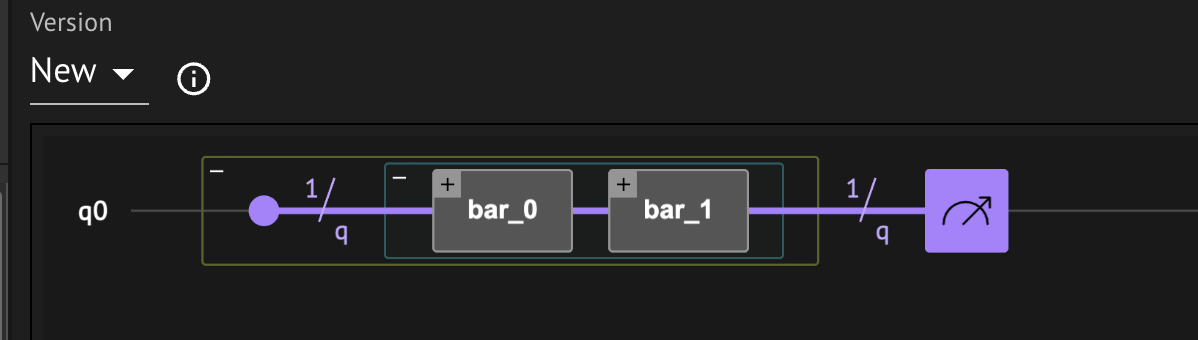
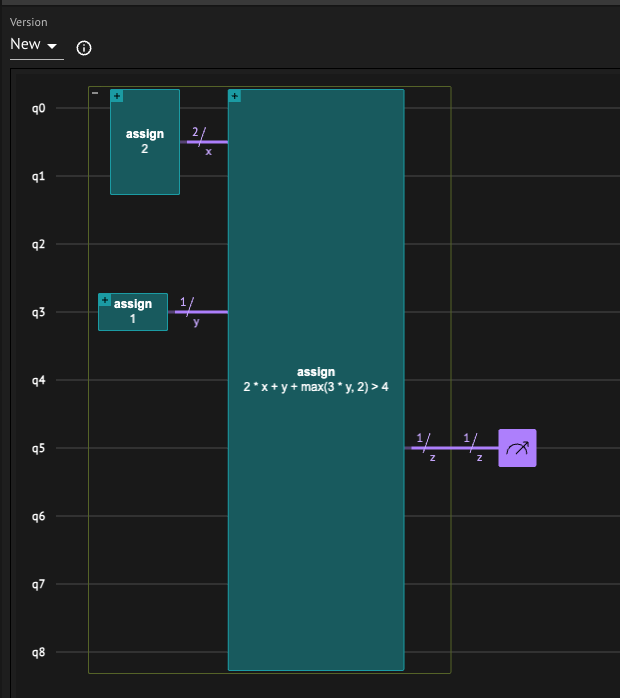
- Statements with quantum expressions now display their corresponding expression directly on the block.
2025-03-24
Interface Changes
- The functions
construct_qsvm_model,construct_finance_model, andconstruct_grover_modelhave been removed from the SDK. Check out our Qmod implementations of the QSVM, finance, and Grover algorithms in the Classiq library.
2025-03-20
Enhancements
- Improve
controlstatement visualization to distinguish control qubits from target qubits.
2025-03-18
Enhancements
- Add new execution backends
BRAKET_NVIDIA_SIMULATORandBRAKET_NVIDIA_SIMULATOR_STATEVECTOR. These simulators run on Amazon Braket’s infrastructure and provide faster execution for single circuits. See Execution on Classiq Backends for more information. - Improve
prepare_amplitudesandprepare_stateperformance forbound=0. - Add
RESET, an atomic function that resets a qubit to the|0>state. - Intel simulator is now available as a backend for execution. See Cloud Providers section in the user guide.
2025-03-10
2025-02-26
Enhancements
- Improve depth and gate count for transpilation options “intensive” and “custom”.
- Improve the synthesis of the
suzuki_trotterfunction for small Hamiltonians. - Updated the Quantum program icon in the drawer to a newer version.
Bug Fixes
- Fixed a bug where arithmetic expressions that classically evaluate to constant boolean values could not be used.
- Fixed a bug where using the
showfunction in the Python SDK would open the IDE with a “Not Authorized” error. - Fixed a bug where certain operations in the Quantum Program visualization are displayed with very long name that describes the operation’s hierarchy.
2025-02-17
Classiq Studio
We’re launching Classiq Studio!
Classiq Studio is a web-based coding environment where you can write and run Python code in a pre-configured setup. Access it now via the Classiq Platform. For details, see the Classiq Studio user guide.Enhancements
- Improved the synthesis of the
molecule_uccfunction for small molecules. - Social Sharing is now available. You can share circuits to various social platforms.
- Added SLSQP optimizer for use in VQE.
Interface Changes
- Introduced a new QMOD core-library function
commuting_paulis_exponent.
Bug Fixes
- Fixed unexpected resets when using Classiq Studio.
Support
- Error messages now include a link to our support system for reporting bugs or opening support tickets. You can also reach us on our Slack community channel.
2025-02-11
Enhancements
- Arithmetic assignments and control conditions now support quantum subscript
expressions.
A quantum subscript expression comprises a classical list accessed by a quantum
subscript, e.g.,
x |= subscript([1, 2, 3, 4], y)(in Native Qmod:x = [1, 2, 3, 4][y];). - Report an indicative error when not releasing local variables inside control, invert and power statements.
- When running VQE using the
ClassiqSimulatorBackendNames.SIMULATOR_STATEVECTORbackend, compute the expectation value directly from the state vector instead of running shots. - In the Python SDK, arguments of type
CArraycan now be NumPy arrays, tuples, and similar sequential objects. For example, the following statements are equivalent:prepare_state([0.25, 0.25, 0.25, 0.25], 0, q)andprepare_state(np.ones(4) / 4, 0, q).
Interface Changes
- The
synthesizeandwrite_qmodfunctions now accept a quantum entry point. Instead ofsynthesize(create_model(main)), writesynthesize(main).
2025-02-02
Enhancements
- Unreleased local variables of a function are now un-computed and released when calling the function under a compute block of a
Within-apply
Bug Fixes
- Fix control optimization for constant equality conditions
(e.g.,
control(x == 1, ...)) producing wrong circuits under certain conditions. - Fix in-place XOR optimization for classical values (e.g.,
x ^= -0.5) producing wrong circuits under certain conditions. - Fix in-place XOR optimization for Boolean expressions
(e.g.,
x ^= (y > 0) & (z > 0)) producing wrong circuits under certain conditions. - Fix a bug causing an internal error in arithmetic expression that use comparison,
subtraction, or negation (e.g.
x > 0.3,0.2 - x,-x) when synthesizing models with the machine precision set to higher than 8.
2025-01-27
Interface Changes
- Add the functions
amplitude_amplificationandexact_amplitude_amplificationto the function library.
2025-01-20
Enhancements
-
The
num_qubitsargument of functionallocateis now optional. If it is not specified, it is inferred automatically according to the quantum type of the allocated variable. Example: -
The
executeparameter of theQLayerobject is now optional. Example:
Deprecations
The simulator name “nvidia_state_vector_simulator” has been removed. Please use ClassiqNvidiaBackendNames.SIMULATOR or “nvidia_simulator” instead.Classiq IDE
- The Application Configuration Panel used for editing examples in the Built-in Apps folder has been removed.
- Patched dependencies: Katex.
2025-01-14
Bug Fixes
- Fix failed execution jobs which stay in “running” status forever instead of reporting an indicative error.
2025-01-08
Enhancements
- The name argument of local quantum variables
is now optional. If a name is not specified, it is inferred automatically from
the Python code. For example, it is now possible to write
q = QBit()instead ofq = QBit("q"). - Improve the performance of executing multiple primitives inside one
ExecutionSession, such as inexecute_qaoa.
Classiq IDE
Share Quantum Programs with anyone. For more information, see Sharing your Quantum Program Visualization.Deprecations
Functionprepare_int and inplace_prepare_int are now deprecated. Use Qmod out-of-place
and in-place numeric assignment statements instead. For example, instead of prepare_int(5, my_qnum),
write my_qnum |= 5.
See more under numeric assignments.2024-12-29
Enhancements
- Improve error messages.
Bug Fixes
- Fix quantum bits raising an error when used in in-place assignments
(
^=and+=). - Fix quantum struct field access raising an error in lambdas.
Classiq IDE
- Classiq Thumbnail: Updated the Classiq thumbnail image!
- Links on the IDE model page now directing to Classiq Library.
- Modify the Quantum Programs URL so that the circuit ID is embedded in its path
New Visualization:
Compact View:- Clean up variable names in engine blocks.
- Corrected the spacing miscalculation for junction dots.
- Refined padding before allocation
- Hide labels in open functional blocks to create a more space-efficient display.
- Removed unnecessary dots and labels for low-level QC elements.
2024-12-23
Enhancements
- Generative functions have undergone a round of significant improvements. Check out our DQI notebook to see how generative functions are used to implement advanced quantum algorithms.
- A new filed
optimization_levelhas been added thePreferencesof the synthesis. This field determines the trade-off between synthesis speed and the quality of the results, In terms of the optimization parameter and the constraints. For more information, see here. - State vector filtering is available. This is an important step for simulating large circuits with a state vector simulator. For more information, see this page
Bug Fixes
- Fix usage of overlapping quantum array slices (e.g.,
qbv[1:3]andqbv[2]) in bodies of lambda expressions and control statements.
2024-12-16
Enhancements
- Added a new simulator under the Classiq provider, under the name
ClassiqNvidiaBackendNames.SIMULATOR_STATEVECTOR. This simulator runs on a GPU and returns a state vector, similar toClassiqSimulatorBackendNames.SIMULATOR_STATEVECTOR(which runs on a CPU). Thus, it can handle larger circuits. The name"nvidia_state_vector_simulator"is deprecated in favor ofClassiqNvidiaBackendNames.SIMULATOR. See here for more information.
Bug Fixes
- Fix the connectivity map of the
rigetti.qpu.ankaa-9q-3backend in Azure Quantum. - Fix the connectivity map of Amazon Braket devices.
- Fix a bug in the method
from_idofExecutionJob.
Deprecations
- Parameters
valueandtargetof functionsinplace_addandinplace_xorhave been renamed toexpressionandtarget_varrespectively.- In Native Qmod, use
+=and^=instead ofinplace_addandinplace_xorrespectively.
- In Native Qmod, use
Classiq IDE
- Qmod examples on the Model page now contain direct links to their respective tutorials in the Classiq documentation. Simply hover over an algorithm list item from the QMODs list in the left panel and a tooltip will appear with link to the relevant tutorial.
New Visualization:
- Captured variables are now shown as uninitialized.
2024-12-10
Enhancements
- Add a demonstration of the Decoded Quantum Interferometry (DQI) algorithm. See notebook.
Bug Fixes
- Operands’ list elements can be used as operands (in expressions such as,
e.g.,
[op_list[0]]).
Interface Changes
- Add the function
qsvt_lcufor efficiently encoding QSVT polynomials with indefinite parity. - Subsequent invocations to execution primitives inside
ExecutionSessionnow use different random seeds (depending on the initial seed) to avoid getting the exact same simulation results inside a session.
Classiq IDE
New Visualization:
- Clean up variable names in engine blocks.
2024-11-28
Interface Changes
ExecutionSessionneeds now to be explicitly closed, and it is recommended to use it as a context manager. See here for more information.
Classiq IDE
- Credentials for Alice & Bob hardware are now optional. Quantum programs run on Alice & Bob backends will use Classiq’s credentials by default.
2024-11-25
2024-11-18
Enhancements
- This release introduces a new version to the Quantum Program (QP) visualization tool in parallel to the legacy visualization.
- The new visualization version offers advanced visualization capabilities that bridge high-level algorithmic descriptions (Qmod) with gate-level implementations, incorporating interactive hierarchical views and data flow analysis.
Feature Details
Visualization Versions:
Both the new version and the legacy version are available on the Quantum Program page. Users can toggle between two visualization versions:- ‘New’ version: Advanced visualization that includes quantum data flow views and new hierarchical block structures.
- ‘Basic’ version: Legacy visualization.
Documentation & Support:
Initial documentation : A basic guide is available to help users navigate and utilize the visualization tool’s key features.Tooltip: Integrated to the QP page to provide in-line initial guidance on key functions and elements.Known Issues and Limitations:
Supported models: The ‘New’ visualization doesn’t yet support all models. Unsupported models may not render - in these cases it is suggested to switch back to the ‘Basic’ visualization.In-Progress development: This is part of an initial release milestone, with major issues being actively addressed.Usage Recommendations
Switching between versions: It’s recommended to switch between the ‘New’ and ‘Basic’ versions to evaluate visualization consistency and effectiveness for specific quantum programs.Feedback and bug reporting: Any issues, inconsistencies, or suggested improvements should be reported through the designated Slack channel for prompt review.Next Steps
User feedback will inform ongoing improvements and prepare the tool for broader production release. Further enhancements and bug fixes are planned in alignment with Classiq’s high-level quantum design roadmap.2024-11-11
Bug Fixes
- Fix walkthrough bug in the IDE.
- Change the default value of display_url in show(circuit, display_url) to True.
2024-10-31
2024-10-28
Enhancements
- Qmod/Python: Functions
assign,assign_amplitude,inplace_xor, andinplace_addare equivalent to the operators|=,*=,^=, and+=respectively except that they can be used in operands (Python lambda functions):
- Support non-equation Boolean expressions as control conditions:
- SDK
- Native
Interface Changes
- Parameters
valueandtargetof functionsinplace_addandinplace_xorhave been renamed toexpressionandtarget_varrespectively. Parametersvalueandtargetwill no longer be supported starting on 02/12/24 at the earliest.
Bug Fixes
- Solve a within-apply bug.
2024-10-21
Deprecations
- Python 3.8 is no longer supported in the Python SDK. The minimum supported version is now Python 3.9.
Enhancements
- Optimize in-place XOR variable assignments (
x ^= y). (The implementation no longer uses auxiliary qubits.) - Improve error messages in
CArray(array) parameter declaration. - Support array subscripts and struct field access on the left-hand side of
in-place arithmetic assignments (
qbv[0] ^= 1andmy_Struct.field += 2.5). - Optimize the controlled version of QFT arithmetic implementations by skipping controlling the QFT and QFT dagger.
2024-10-14
Enhancements
- Introducing generative functions
to the Python SDK. Generative functions are
@qfuncs that support Python control flow, integration with third-party libraries, and debugging. - Execution using IBM devices is available again.
- New method
estimation_costinExecutionSessionevaluates a quantum circuit given a classical cost function. - A new
+=operator performs
in-place addition
Example:
z += x ** 2 - 0.5 * y
5. The state of SampledState supports dot-notation for field access when
representing a quantum struct:- Add a new example for hybrid classical-quantum neural network. See notebook.
Interface Changes
- Parameter
controlof built-in functions such asCXhas been renamed toctrl. Parametercontrolwill no longer be supported starting on 4/11/24 at the earliest. - Add two new functions for encoding classical data,
encode_in_angleandencode_on_bloch. See notebook.
Bug Fixes
- Fix classical array slicing in the SDK (
my_list[1:3][0]). - Fix synthesis of arithmetic operations nested in a within-apply statement
when
machine_precisionis set. - Fix in-place arithmetic operations (
^=/+=) when the value on the right-hand side is a signed variable that is not aligned with the target variable.
2024-10-02
Enhancements
- Optimize synthesis of variable and constant assignments (
x ^= y,x += 3). - The behavior of synthesis with
debug_modeset toFalsehas been changed, such that synthesis process is up to 50% faster. However, the resulting visualized quantum program may lose much of its hierarchical structure. Note that the default value for debug_mode is stillTrue, and this mode’s behavior remains unchanged. - The maximum number of shots in a single execution on Nvidia simulators has been increased to 1,000,000.
Bug Fixes
- Improve circuit width estimation when
machine_precisionis set. - Removing the non-gate-based devices from the available AWS Bracket devices.
- Fix
n ^= 1assignments wherenhas a single qubit (used to raise an exception).
Notice
-
With the release of this version (
0.52.0), execution with older SDK versions may result in errors or unexpected behavior. To ensure proper execution of your quantum programs via the SDK, please upgrade to the latest version (See instructions guide above). -
The
Pydanticpackage dependency has been upgraded from version 1 to version 2. If you are using an older version ofPydanticin the same environment as our SDK, this may lead to compatibility issues. Note that installing or upgrading the SDK will also update yourPydanticversion to V2. It is recommended to verify compatibility across your environment.
2024-09-30
Bug Fixes
- Allow the sign qubit of a quantum numeric variable to overlap the fraction
digits (e.g.,
qnum[1, SIGNED, 1]).
2024-09-29
Notice
- With the release of version
0.52(scheduled for the week of 06-12.10.2024), execution with older SDK versions might result in errors or unexpected behavior. In order to make sure executions of your quantum programs via the SDK work properly upgrade your SDK to the latest version (See instructions guide above).
Enhancements
- Improve qubit reuse in arithmetic operations when
machine_precisionis set. - Improve error messages when executing circuits on Amazon Braket.
- Improve error messages when executing the VQE primitive.
- Support constant assignments:
x |= 3,x ^= 3, andx += 3.
Bug Fixes
- Fix in-place XOR assignments (
^=) of 1-qubit expressions into multi-qubit variables (used to raise an error).
Interface Changes
- Add a new function,
quantum_program_from_qasm, to convert a QASM string into a Quantum Program.
2024-09-23
Notice
- With the release of version
0.52(scheduled for the week of 06-12.10.2024), execution with older SDK versions might result in errors or unexpected behavior. In order to make sure executions of your quantum programs via the SDK work properly upgrade your SDK to the latest version (See instructions guide above).
2024-09-16
Notice
- With the release of version
0.52(scheduled for the week of 06-12.10.2024), execution with older SDK versions might result in errors or unexpected behavior. In order to make sure executions of your quantum programs via the SDK work properly upgrade your SDK to the latest version (See instructions guide above).
Bug Fixes
- Raise indicative error when circuit cannot be visualized.
- Fixed synthesis of arithmetic operations nested in a within-apply statement
when
machine_precisionis set.
2024-09-10
Enhancements
- Improved error messages.
- Added
SIGNEDandUNSIGNEDbuilt-in constants to improve readability of QNum types. SDK:QNum[4, SIGNED, 1]. Native:qnum<4, SIGNED, 1>. QNumtypes can specify just the size property. SDK:QNum[4]andQNum("n", 4). Native:qnum<4>. Such types are unsigned (is_signed=False) integers (fraction_digits=0) by default.- Execution on remote providers is no longer subject to any time limit when using
ExecutionSessionor executing models without classical execution code. Note: simulation on Classiq backends is still subject to time limit. - In-place add operations (
inplace_add) now support signed variables. - Added a new notebook for solving the Differential equation using the HHL Algorithm, to simulate war games.
Bug Fixes
- Fixed an operand-related bug. Might occur when calling a function recursively
in one of its operands (for example:
foo(lambda: foo(...))). - Fixed an expression-related bug. Might occur when using the same variable in multiple expressions.
- Fixed in-place XOR operations (
^=/inplace_xor) in the presence of signed variables. The sign variable is now interpreted as part of the significand without special treatment. - Fixed synthesis of arithmetic operations nested in a within-apply statement.
Interface Changes
- SDK: Deprecated parameter names in built-in operations were removed.
control(ctrl=..., operand=...)=>control(ctrl=..., stmt_block=...)within_apply(compute=..., action=...)=>within_apply(within=..., apply=...)power(power=..., operand=...)=>power(exponent=..., stmt_block=...)invert(operand=)=>invert(stmt_block=...)
2024-09-02
Enhancements
- Cancelling an execution job will now result in cancellation of any ongoing jobs sent to the provider during the execution. For more information, see Cancellation.
- The Classiq SDK now supports Python 3.12.
- Added a new tutorial on the Oblivious Amplitude Amplification algorithm.
2024-08-21
2024-08-04
Bug Fixes
- Fixed a bug related to boolean arithmetic expressions with invert.
- Fixed a bug related to arithmetic expressions inside within-apply.
Classiq IDE
- Add back improved circuit nodes search.
- Fix bug in Quantum Program page .qprog file extensions uploads.
- Poll all active jobs in the job list, not just the selected job.
- Add support for Alice & Bob hardware configurations in the IDE.
Enhancements
- Add support for arithmetic boolean expressions as conditionals for control statements; see here.
- Add quantum structs.
- The element type of quantum arrays can be any quantum type. N-dimensional quantum arrays are supported.
- Operand parameter names are optional in both Native
(
qfunc (indicator: qbit)->qfunc (qbit)) and Python (QCallable[QBit]->QCallable[Annotated[QBit, "indicator"]]) Qmod. - Improve error messages.
- Provide better circuits for certain boolean arithmetic expressions.
- Improved qubit reuse and runtime performance for model without constraints.
- Add
solovay_kitaev_max_iterationsfield to the synthesis preferences, allowing for tuning the accuracy of the Solovay-Kitaev algorithm. - Built-in classical functions to decompose/compose a matrix into/from a Hamiltonian. Example of usage:
- SDK
- parsed_states, parsed_counts, parsed_state_vector will contain the parsed execution details as lists if a quantum array was used in the model.
- SDK
- Added a new tutorial on Hamiltonian simulation for block-encoded Hamiltonians, using QSVT and Qubitization.
- Added a new tutorial on solving the discrete Poisson’s equation using the HHL algorithm, combined with quantum sine and cosine transforms; see here.
- Enhanced the Discrete logarithm example to the case where the order is not a power of 2; see here.
- Updated the Quantum Types documentation page.
Interface Changes
- Some builtin operations parameters have been renamed:
control(ctrl=..., operand=...)=>control(ctrl=..., stmt_block=...)within_apply(compute=..., action=...)=>within_apply(within=..., apply=...)power(power=..., operand=...)=>power(exponent=..., stmt_block=...)invert(operand=)=>invert(stmt_block=...)
- Added new state preparation functions:
prepare_unifrom_trimmed_stateandprepare_unifrom_interval_state; see here.
Deprecations
- SDK: The
@structdecorator has been removed. Define classical structs using@dataclass. - The field
varianceinEstimationResultis deprecated, and will be populated with the value-1until removed. - The field
timeout_secinExecutionPreferences, and the fieldjob_timeoutinAwsBackendPreferences, have been removed. - classical arguments in the native language are now inside the parentheses
section (
(...)) alongside quantum variables and not inside the angle brackets (<...>), the angle brackets section is now considered deprecated. For example, you should migrate:qfunc <a: real> main{...}->qfunc main(a: real) {...}for info refer to the language reference about functions. A Warning was added to the IDE in the case it is used.
2024-07-28
Enhancements
- Error mitigation can now be enabled or disabled for IonQ through Azure in the SDK. Default is set to False.
2024-07-21
Classiq IDE
- Fix infinite loop bug in Quantum Program page.
- Fix Quantum Program deletion bug on Quantum Program page.
2024-07-14
2024-07-07
Enhancements
- Support signed quantum numerics in in-place-xor assignments (
^=). - Support quantum array subscripts in quantum expressions.
- Support quantum numeric arrays.
- Improve synthesis performance.
- Apply an automatic qubit reuse pass when the model is unconstrained.
- Add user-defined enums.
- Added a new technology demonstration notebook for a discrete quantum walk on a circle; see here.
- Added new rainbow options pricing notebooks in the public repository research folder.
- Python
- Native
Interface Changes
- The classical scope in Qmod no longer supports function definitions.
- The
aer_simulator,aer_simulator_statevector,aer_simulator_density_matrix, andaer_simulator_matrix_product_stateClassiq backends are no longer accessible in the SDK. Usesimulator,simulator_statevector,simulator_density_matrix, andsimulator_matrix_product_stateinstead. - The
@structdecorator is deprecated and will be removed in a future release. Use@dataclassinstead.
Bug Fixes
- Fixed a bug where multiple in-place assignment statements resulted in a
22102error. - Fixed a bug where using the same variable in
controloperation for both the control operation and the body resulted in a non-indicative error. - Fix
invertandwithin-applyvariable initialization tracking in native Qmod. - Fix division with classical symbolic variables.
- Fix rogue comma inserted to the chemistry model classical execution code after IDE form update.
- Fix reporting uninitialized quantum variables in arithmetic expressions as undefined.
- Fix double execution on devices requiring access tokens.
- Fix execution configuration being applied only to the first selected device, when one of the selected devices requires an access token.
- Fix a bug where Grover circuit was incorrect when reflecting about states different than uniform superposition.
- Fix a synthesis bug that could appear in models that constrain the width and optimize depth or vice versa.
Classiq IDE
- Graphical Model tab redesign of nodes (Function call, Output, Assignment).
- Restructure of node categories (Graphical Model).
- Fix countries list not loading sometimes during registration.
- Prevent Qmod editor from crashing when compiler crashes.
- Redesigned the Accordion and Icon status for jobs.
- Quantum Program tabs moved to the left drawer.
- Uploading Quantum Program can now be done using the Upload button on the left drawer.
- 3 newly introduced tabs of Quantum Program data: Transpiled Info, Program Info, Data.
2024-06-30
2024-06-23
Enhancements
- HHL workshop was added to the public repository and to the User Guide.
- It is now possible to use the execution primitives
estimateandvqewith models with multiple output ports. The hamiltonian should match all the output ports by their order. - Amplitude encoding assignments (
ind *= foo(n)) support all quantum numeric variables, not only unsigned fractions. - Add support for lookup tables in amplitude encoding assignments, e.g.,
ind *= [0, 0.5, 0.5, 1][n]wherenis an unsigned quantum integer (ind *= subscript([0, 0.5, 0.5, 1], n)in the SDK). - A quantum COSINE and SINE transforms of types I and II were added to the open library, see Quantum COSINE and SINE Transforms.
- New algorithm was added to the library: “Variational Quantum Linear Solver (VQLS) with Linear Combination of Unitaries (LCU) Block Encoding”
Variational Quantum Linear Solver
Alice & Bobprovider is now accessible.
Interface Changes
compute_qaoa_initial_pointis now exposed in the SDK directly fromclassiqpackage.from classiq import compute_qaoa_initial_point- The examples in IDE Flow page are replaced with a new arithmetics example.
Bug Fixes
- Fixed an error related to the translation of certain circuits between synthesis and execution.
- Fixed an error when calling a function with local variables multiple times.
- Properly evaluate type attributes in
main.- Native Qmod:
qnum’s sign field can be specified with lowercasetrue/falseinmain’s signature.
- Native Qmod:
- Fix execution results received from running on Amazon Braket to be correct when the measured outputs are not all of the variables of the model.
- Improve language error reporting.
Classiq IDE
- Uniform drawer width for all pages
- New way to trigger node options context menu on Graphical Model page: node options menu can now be triggered by right-clicking a selected node
2024-06-16
Enhancements
- Performance of synthesis has been improved, most significantly for synthesis requests with no constraints.
2024-06-09
2024-06-02
Enhancements
- Hardware-aware synthesis
will now use the Solovay-Kitaev algorithm to approximate
single-qubit gates when the basis gate set is a specific variation of
Clifford + T (
X,Z,H,T,CX, andCCX). qsvtfunction was added to the function library. See Quantum Singular Value Transformation.- A tutorial on discrete quantum walks was added to the tutorials library. See Discrete Quantum Walk.
- SDK: Quantum functions (
@qfunc) can be recursive. - SDK: PauliTerm can be used to declare a hamiltonian.
- Introducing ExecutionSession which will allow choosing the execution primitive in the SDK without the need of changing/synthesizing the quantum program once again.
- A Qmod library reference, with usage examples for built-in and open library functions, can now be found in the function menu.
Interface Changes
- SDK: In
execute_qnn, the optional argumentobservablesof typePauliOperatorshas been replaced with the optional argumentobservableof typePauliOperator.
Deprecations
- SDK: The
quantum_ifoperation and the oldcontrolsyntax have been removed.
quantum_ifis removed. Usecontrolinstead.control(operand, ctrl)is no longer supported. Usecontrol(ctrl, operand)instead.control(n, operand)does not support quantum numeric variables (n). Instead, use abindoperation to castninto a quantum array, or comparento an integer explicitly (e.g.,n == 7).
- SDK: The
QParamtype has been removed.
- Instead of
QParam[int], useCInt. - Instead of
QParam[float], useCReal. - Instead of
QParam[bool], useCBool. - Instead of
QParam[List[...]], useCArray[...]. - Instead of
QParam[Array[..., size]], useCArray[..., size].
-
Native Qmod: Accessing quantum variable properties (e.g.,
qbv.lenorn.is_signed) via function call syntax (len(qbv),is_signed(qbv)) is no longer supported. -
The field
optimizer_preferencesofExecutionPreferenceshas been removed. -
The function
set_initial_valueshas been removed.
Classiq IDE
- “Slack” and “Learn More” links were moved from the side drawer to the IDE header. New links were added as well: Community, User Guide.
- Allow visualization of larger circuits and prolong the timeout for visualization
-
Users can now download a LaTeX format of their quantum programs directly from
the IDE, allowing for easy sharing, publication, and presentation of their
work.
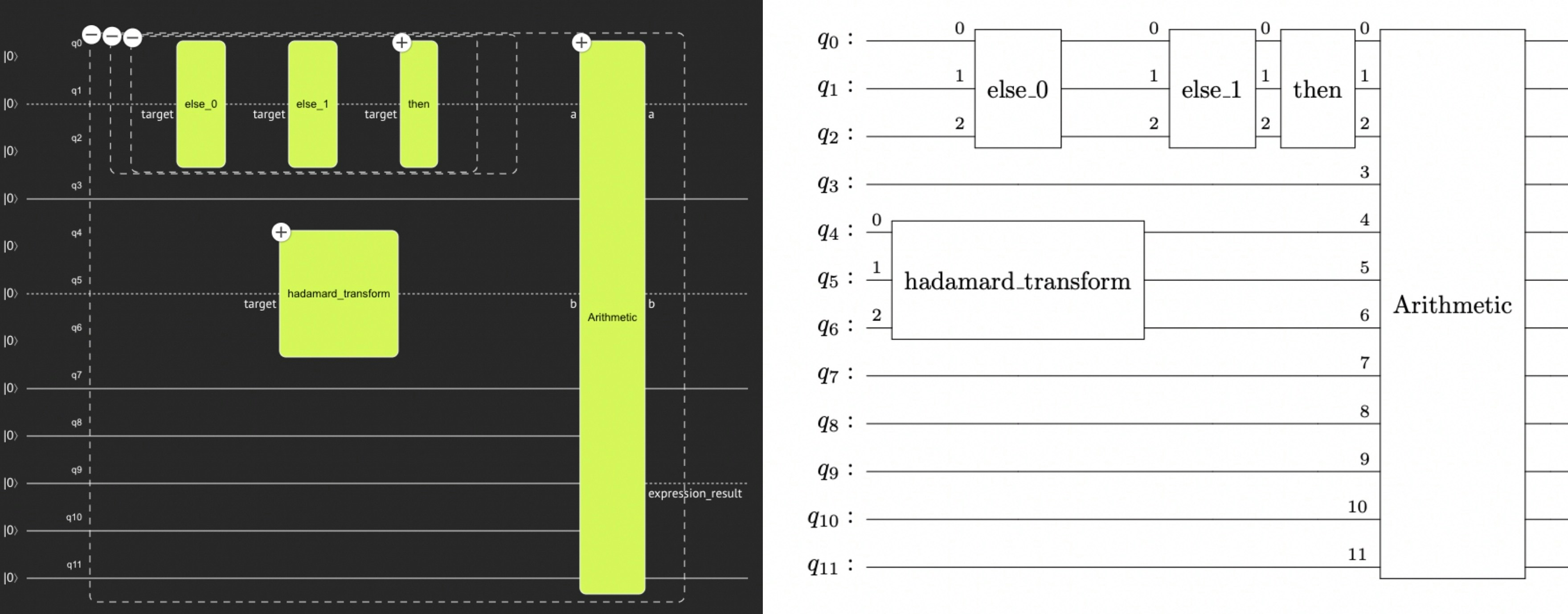
- Cookies settings are now available to adjust the given consent at any time.
Bug Fixes
- “selected example not found” error when opening the IDE
- Resetting now clears preferences form instead of initializing from cache on the model page
- Naming for exported files on the Graphical Editor
- State vector measurement results ordering
- Parameter names in lambda expressions don’t have to match the parameter names in operand declarations:
- Python
- Native
2024-05-26
Interface Changes
- The
controlandquantum_ifstatements have been unified into one statement in native Qmod and the SDK under the namecontrol.- SDK: The unified
controlstatement accepts a qbit (q), a q-array (qbv), or a comparison of a qnum and an integer (n == 5) as the first argument. - SDK: The old
controlsyntax (withctrlas the second argument) is deprecated and will be removed in the next release. - SDK: The
quantum_ifoperator is deprecated and will be removed in the next release. - Native Qmod:
quantum_ifis no longer supported, use the newcontrolstatement instead.
- SDK: The unified
- SDK: The
QParamandArraytypes are deprecated and will be removed in the next release.- Instead of
QParam[int], useCInt. - Instead of
QParam[float], useCReal. - Instead of
QParam[bool], useCBool. - Instead of
QParam[List[...]], useCArray[...]. - Instead of
QParam[Array[..., size]], useCArray[..., size].
- Instead of
- SDK: Using Python types (
int,bool, etc.) in struct declarations (@struct) is deprecated and will not be supported by the next release. Instead, use classical data types (CInt,CBool, etc., see above). - Default timeout for sending jobs to AWS changed from 5 minutes to 4 hours.
Deprecations
- The error mitigation settings in the execution preferences are no longer available.
- The
aer_simulatorbackend has been removed. Use Classiq’s simulator backend instead (ClassiqSimulatorBackendNames.SIMULATOR).
Enhancements
- Improved error messages.
Bug Fixes
- Fixed a bug preventing execution of circuits synthesized with hardware aware synthesis on Azure and IonQ.
2024-05-19
Enhancements
- Improved the native Qmod syntax of the
repeat,ifstatements. For details, see Classical Control Flow. - Improved the native Qmod syntax of the
control,power, andinvertstatements. For details, see Quantum Operators. - Added the
classiq.execution.all_hardware_devices.get_all_hardware_devicesfunction to the Python SDK.
Deprecations
- In the SDK, the
classiq.analyzer.analyzer.Analyzer.get_available_devicesmethod is deprecated. Useclassiq.execution.all_hardware_devices.get_all_hardware_devicesinstead.
Interface Changes
- The
lenmethod forQArray,QCallableList, andQParamof lists, is now a property. use.leninstead of.len().
2024-05-12
Overview
Release 0.38 achieves a major milestone in the migration to the new Qmod language. The following general changes are now in effect:- In the IDE, Synthesis page is now removed. Writing and synthesizing models is now done exclusively in the Model page.
- All pre-defined models previously available in the Synthesis page in Json format are now available in the Model page in native Qmod syntax.
- Many Qmod language enhancements were introduced to enable the coding of all available models and applications, in both native Qmod and in its Python embedding (see detailed list below).
- A new Qmod reference manual, covering all the language concepts and constructs in both input formats, is available Qmod-language-reference.
- Documentation content covering old input formats - the Json input and the old SDK classes - has been removed
Enhancements
- Native Qmod now supports classical POD struct declaration, initialization, and member access.
- Native Qmod now supports within-apply statements.
- Native Qmod now supports generalized in-place quantum assignment.
- Native Qmod now supports global constants.
Interface Changes
- The
QStructdecorator was renamed tostructin theqmod-python integration. - The
qfuncdecorator is renamed toquantum_function. The newerQFuncandExternalQFuncdecorator are now available asqfuncandqfunc(external=True). Using either classes as a decorator is deprecated, and this feature may be removed in a future release. - Similarly, a new
cfuncdecorator is now available, and using the classCFuncas a decorator is deprecated and may be removed in the future. - Renamed
GeneratedCircuittoQuantumProgramin the SDK. - The
QNumtype does not accept size argument without sign and fraction digits. QNumon the right-hand side ofbindstatements must have sign and fraction digits (inferred from initialization or declaration).- The Following async methods were removed from
Analyzerclass (The documented methods without theasyncsuffix are still available and can be used instead):get_available_devices_asyncanalyzer_app_asyncplot_hardware_connectivity_asyncget_hardware_comparison_table_async
- The method
show_multiple_hardware_datawas removed fromRBAnalysisclass. The async equivalentshow_multiple_hardware_data_asynccan be used instead. - Removed
reinterpret_numoperation (instead useQNum/allocate_numarguments). - Removed
splitandjoinoperation (instead usebindoperation). - Added method
parsed_counts_of_outputsto sample’s result in the Python SDK; see sample. - Constants can now be used in the
qmod-python integration with theQConstantclass. - The quantum numeric type can now receive sign and fraction digits as type arguments in parameter declarations, in both the SDK and native Qmod.
- Native Qmod example:
qnum<5, True, 2>to indicate a 5-bit signed number with 2 fraction digits. - SDK examples:
QNum[5, True, 2]to indicate a 5-bit signed number with 2 fraction digits (as a function argument)QNum("x", 5, True, 2)to indicate a 5-bit signed number with 2 fraction digits (as a local variable)
- Native Qmod example:
- The amplitude encoding flavor of quantum arithmetic (
*=operator) is now an in-place operation in both the SDK and native Qmod.