View on GitHub

Open this notebook in GitHub to run it yourself
The code here can be integrated as part of a larger CFD solver, e.g., as in qc-cfd repository. In particular, instead of calling a classical solver, e.g., x = sparse.linalg.spsolve(mat_raw_scr, b_raw), one can call the quantum solver qsvt_solver(mat_raw_scr, b_raw,...). We implemented two versions for block-encoding, one based on Pauli decomposition of the matrix, and another one based on decomposing the matrix to a finite set of diagonals.
!pip install -qq -U "classiq[qsp]"
!pip install -qq "classiq[chemistry]"
We start with defining the main function qsvt_solver, which gets the matrix and right-hand-side vector, applies the quantum solver, and returns the linear equation solution using a statevector simulator. The solvers in this directory were developed in the framework of exploring their performance in hybrid CFD schemes. For simplicity, it is assumed that all the properties of the matrices are known explicitly. In particular, we calculate its singular values for identifying the range in which we apply the inversion polynomial.
import time

import matplotlib.pyplot as plt
import numpy as np
from banded_be import get_banded_diags_be
from cheb_utils import *
from classical_functions_be import get_svd_range
from pauli_be import get_pauli_be
from scipy import sparse

from classiq import *
from classiq.applications.qsp import qsvt_phases
from classiq.applications.qsp.qsp import poly_inversion

np.random.seed(53)

PAULI_TRIM_REL_TOL = 0.1

def qsvt_solver(
    mat_raw_scr,
    b_raw,
    poly_degree,
    be_method="banded",
    preferences=Preferences(),
    constraints=Constraints(),
):

    scale = 0.5
    b_norm = np.linalg.norm(b_raw)  # b normalization
    b_normalized = b_raw / b_norm

    # Define block encoding
    if be_method == "pauli":
        data_size, block_size, be_scaling_factor, be_qfunc = get_pauli_be(
            mat_raw_scr, PAULI_TRIM_REL_TOL
        )
        print(
            f"Pauli block encoding with block size {block_size} and scaling factor {be_scaling_factor}"
        )

    elif be_method == "banded":
        data_size, block_size, be_scaling_factor, be_qfunc = get_banded_diags_be(
            mat_raw_scr
        )
        print(
            f"Banded diagonal block encoding with block size {block_size} and scaling factor {be_scaling_factor}"
        )

    class BlockEncodedState(QStruct):
        data: QNum[data_size]
        block: QNum[block_size]

    # Get SVD range
    w_min, w_max = get_svd_range(mat_raw_scr / be_scaling_factor)
    # Get Chebyshev polynomial and the corresponding QSVT angles
    c, m = poly_inversion(poly_degree, 1 / w_min, "relative")
    pcoefs, poly_scale = scale * c / m, scale / m
    inv_phases = qsvt_phases(pcoefs)

    # Define QSVT projector
    @qfunc
    def projector(be: BlockEncodedState, res: QBit):
        res ^= be.block == 0

    @qfunc
    def main(
        qsvt_aux: Output[QBit],
        data: Output[QNum[data_size]],
        block: Output[QNum[block_size]],
    ):
        allocate(qsvt_aux)
        allocate(block)
        prepare_amplitudes(b_normalized.tolist(), 0, data)

        be_state = BlockEncodedState()

        within_apply(
            lambda: bind([data, block], be_state),
            lambda: qsvt_inversion(
                inv_phases,
                lambda aux: projector(be_state, aux),
                lambda: be_qfunc(be_state.block, be_state.data),
                qsvt_aux,
            ),
        )

    start_time_syn = time.time()
    qprog = synthesize(main, preferences=preferences, constraints=constraints)
    print("time to syn:", time.time() - start_time_syn)

    start_time_exe = time.time()
    sv = calculate_state_vector(qprog, filters={"block": 0, "qsvt_aux": 0})
    proj_statevector = np.zeros(2**data_size, dtype=complex)
    proj_statevector[sv["data"].to_numpy()] = sv["amplitude"].to_numpy()
    indices = np.where(np.abs(proj_statevector) > 1e-13)[0]
    if len(indices) > 0:
        global_phase = np.angle(proj_statevector[indices[0]])
        resulting_state = np.real(proj_statevector / np.exp(1j * global_phase))
    else:
        resulting_state = np.zeros(2**data_size)
    print("time to exe:", time.time() - start_time_exe)

    normalization_factor = (be_scaling_factor * poly_scale) / b_norm

    return resulting_state / normalization_factor, qprog
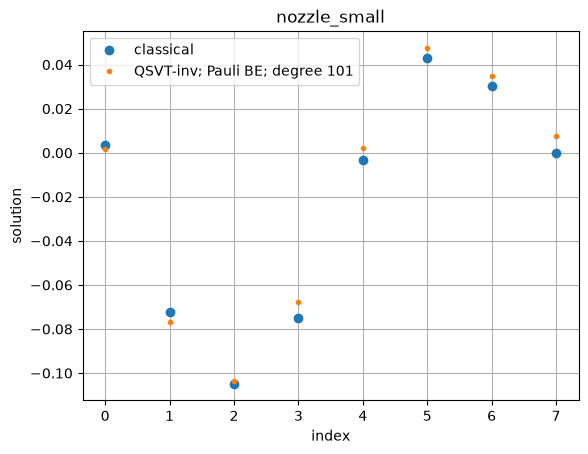
We examine two usecases, starting with a small one, and applying a Pauli-LCU block encoding.
prefs = Preferences()

import pathlib

path = (
    pathlib.Path(__file__).parent.resolve()
    if "__file__" in locals()
    else pathlib.Path(".")
)

mat_small_scr = sparse.load_npz(path / "matrices/nozzle_small_scr.npz")
b_small = np.load(path / "matrices/b_nozzle_small.npy")
print(f"nozzle_small: {mat_small_scr.shape[0]}x{mat_small_scr.shape[1]}")
Output:
nozzle_small: 8x8
  

qsol_small_pauli, qprog_small_pauli = qsvt_solver(
    mat_small_scr,
    b_small,
    poly_degree=101,
    be_method="pauli",
    preferences=prefs,
    constraints=Constraints(optimization_parameter="width"),
)
show(qprog_small_pauli)
Output:
number of Paulis before/after trimming 24/20
  Pauli block encoding with block size 5 and scaling factor 5.557119918538639
  

Output:

Submitting job to simulator
  

Output:
time to syn: 194.59005403518677
  

Output:

Job: https://platform.classiq.io/jobs/2770fe10-ee32-4dbf-8eb5-3d5929996e44
  

Output:
time to exe: 21.43983793258667
  Quantum program link: https://platform.classiq.io/circuit/3DqBaa1JyKpdP4PL71mpJcJufY9
  

We plot the solution vector, and compare to the expected classical result:
expected_small = np.linalg.solve(mat_small_scr.toarray(), b_small)
ext_idx = np.argmax(np.abs(expected_small))
correct_sign = np.sign(expected_small[ext_idx]) / np.sign(qsol_small_pauli[ext_idx])
qsol_small_pauli *= correct_sign
plt.plot(expected_small, "o", label="classical")
plt.plot(qsol_small_pauli, ".", label="QSVT-inv; Pauli BE; degree 101")
plt.title("nozzle_small")
plt.xlabel("index")
plt.ylabel("solution")
plt.legend()
plt.grid(True)
plt.show()
output
assert np.linalg.norm(qsol_small_pauli - expected_small) < 0.1
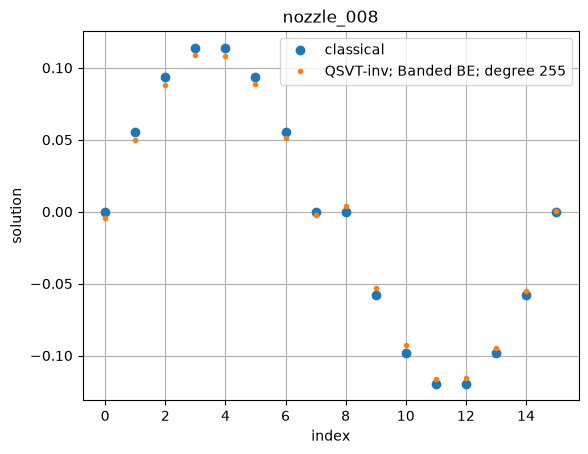
Next, we move to a larger problem. In a hybrid algorithm, we can relax some of the synthesis preferences to obtain the result a faster (for example, we can set debug_mode=False as we can skip the visualization of the quantum program). For the larger usecase we work with the Banded Diagonals block-encoding. We compare the approximated version of the solver to the exact one.
mat_008_scr = sparse.load_npz(path / "matrices/nozzle_008_mat.npz")
b_008 = np.load(path / "matrices/nozzle_008_b.npy")
print(f"nozzle_008:   {mat_008_scr.shape[0]}x{mat_008_scr.shape[1]}")
Output:
nozzle_008:   16x16
  

prefs = Preferences(
    transpilation_option="none",
    optimization_level=0,
    debug_mode=False,
    qasm3=True,
)

qsol_008_banded, qprog_008_banded = qsvt_solver(
    mat_008_scr,
    b_008,
    poly_degree=2 * (2**7 - 1) + 1,  # taking the same degree as in qls_chebyshev_lcu
    be_method="banded",
    preferences=prefs,
    constraints=Constraints(optimization_parameter="width"),
)
Output:

Banded diagonal block encoding with block size 4 and scaling factor 6.097617696340303
  

Output:

Submitting job to simulator
  

Output:
time to syn: 169.09099125862122
  

Output:

Job: https://platform.classiq.io/jobs/1011bac7-83f6-4790-a63e-cbc32c8b9fec
  

Output:
time to exe: 95.1099259853363
  

expected_008 = np.linalg.solve(mat_008_scr.toarray(), b_008)
ext_idx = np.argmax(np.abs(expected_008))
correct_sign = np.sign(expected_008[ext_idx]) / np.sign(qsol_008_banded[ext_idx])
qsol_008_banded *= correct_sign
plt.plot(expected_008, "o", label="classical")
plt.plot(qsol_008_banded, ".", label=f"QSVT-inv; Banded BE; degree {2*(2**7-1)+1}")
plt.title("nozzle_008")
plt.xlabel("index")
plt.ylabel("solution")
plt.legend()
plt.grid(True)
plt.show()
output
assert np.linalg.norm(qsol_008_banded - expected_008) < 0.1