

View on GitHub
Open this notebook in GitHub to run it yourself
- Hamiltonian Simulation with GQSP
- Hamiltonian Simulation with QSVT
- Hamiltonian Simulation with Qubitization
The Expansion
The most general form of the Jacobi-Anger expansion [1] gives: from which we can derive Chebyshev polynomial series for the real-valued functions: where is the Bessel function of the first kind of order , and is the Chebyshev polynomial of order . Eq. (1) is directly used in the GQSP method (applied to the walk operator). Eqs. (3)-(4) are used by both the QSVT method and the Qubitization method.Truncation and Error Bound
The infinite series in Eqs. (3) and (4) can be truncated at degree , giving polynomial approximations of and . The required degree for a target approximation error and evolution time is: This scaling, linear in and logarithmic in , is optimal: it matches the quantum query complexity lower bound for Hamiltonian simulation [2]. This is one of the key reasons the block-encoding family of algorithms is asymptotically optimal. Classiq’s QSP application includes all 5 formulas above. Next we demonstrate the approximation for a given evolution time and error , for the expansion of the function and (Eqs. (3) and (4) above).Output:
Approximation Quality
We can visually inspect the approximation quality for and :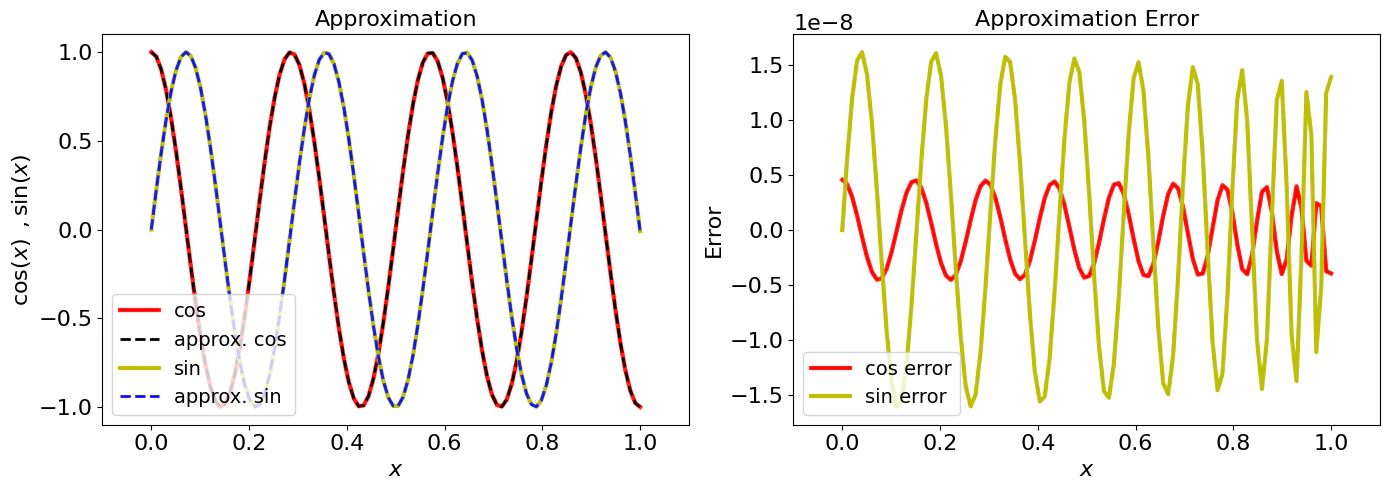
See Also
This expansion is the mathematical foundation used by each of the three Hamiltonian simulation notebooks in this directory:- Hamiltonian Simulation with GQSP - applies Eq. (1) as a Laurent polynomial in the walk operator .
- Hamiltonian Simulation with QSVT - applies Eqs. (3)-(4) as two separate QSVT polynomial transformations, combined via LCU.
- Hamiltonian Simulation with Qubitization - applies Eqs. (3)-(4) directly as Chebyshev coefficients in an LCU of walk operator powers.