
View on GitHub

Open this notebook in GitHub to run it yourself

Building a Geometric Brownian Motion (GBM) Price Model — from Analytic Formula to Quantum Circuit

Motivation

Pricing path-dependent derivatives such as Asian options often requires evaluating a Geometric Brownian Motion (GBM) over many time steps.
  • Classical approach: Monte Carlo simulation over many paths and timesteps.
  • Quantum approach:
  • Compress the representation of randomness (load distributions into amplitudes).
  • Achieve a quadratic speed-up for expectation estimation via Quantum Amplitude Estimation (QAE).
In this notebook we will:
  1. Derive a Chebyshev-truncated Karhunen–Loève (KL) expansion.
  2. Convert that expansion to Classiq quantum arithmetic.
  3. Synthesize hardware-aware circuits for multiple targets with a single command.
Reference: Prakash, Anupam, et al., “Quantum option pricing via the Karhunen–Loève expansion.” (2024) — https://arxiv.org/pdf/2402.10132.pdf

  1. Chebyshev Polynomials in the KL Expansion
We implement the mathematical expression (as appears in the reference article) using Chebyshev polynomials via a recurrence relation. The recursive form maps neatly onto quantum add/mul blocks that Classiq can optimize.

KL expansion (Chebyshev-truncated form)

The KL expansion expresses B(t)B(t) as an orthogonal sine series with i.i.d. Gaussian coefficients aka_k. In truncated form: BL(t)=pL(a,cos(t))=a0t+2πsin(πt)k=0L1akkUk(cost(πt))B_L(t) = p_L(a,cos(t)) = a_0t+\frac{\sqrt{2}}\pi sin(\pi t)\sum_{k=0}^{L-1}\frac{a_k}k U_k(cost(\pi t)) where UkU_k are Chebyshev polynomials of the second kind.

Gaussian discretization (classical preprocessing)

Goal: build a discrete approximation of a Gaussian distribution so that its probabilities can be loaded into amplitudes. Typical steps:
  • Select range [μkσ,μ+kσ][\mu - k\sigma,\, \mu + k\sigma] (e.g., k=3k=3 standard deviations).
  • Use 2n2^n bins for nn qubits.
  • Compute bin probabilities using the Gaussian CDF:
pi=Φ(x{i+1})Φ(xi) p_i = \Phi(x_\{i+1\}) - \Phi(x_i)
  • Normalize the probability vector so ipi=1\sum_i p_i = 1.
Result:
  • A list of grid points (bin edges or centers)
  • A probability vector suitable for amplitude loading.
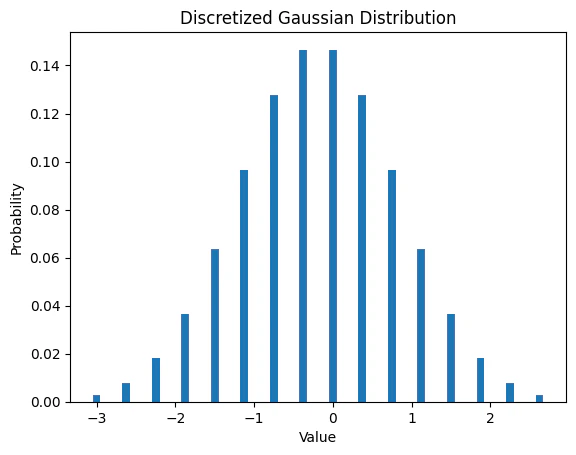
import scipy


def gaussian_discretization(num_qubits, mu=0, sigma=1, stds_around_mean_to_include=3):
    lower = mu - stds_around_mean_to_include * sigma
    upper = mu + stds_around_mean_to_include * sigma
    num_of_bins = 2**num_qubits
    sample_points = np.linspace(lower, upper, num_of_bins + 1)

    def single_gaussian(x: np.ndarray, _mu: float, _sigma: float) -> np.ndarray:
        cdf = scipy.stats.norm.cdf(x, loc=_mu, scale=_sigma)
        return cdf[1:] - cdf[0:-1]

    non_normalized_pmf = (single_gaussian(sample_points, mu, sigma),)
    real_probs = non_normalized_pmf / np.sum(non_normalized_pmf)
    return sample_points[:-1], real_probs[0].tolist()

import numpy as np

from classiq import *

PI = np.pi
L = 4
TIME_STEPS = 1
NUM_QUBITS_GAUSSIAN = 4

MU = 1
SIGMA = 2

grid_points, probabilities = gaussian_discretization(NUM_QUBITS_GAUSSIAN)

# plot the discretized Gaussian
import matplotlib.pyplot as plt

plt.bar(grid_points, probabilities, width=0.1)
plt.title("Discretized Gaussian Distribution")
plt.xlabel("Value")
plt.ylabel("Probability")
plt.show()
output
NUM_QUBITS_GAUSSIAN = 1
grid_points, probabilities = gaussian_discretization(NUM_QUBITS_GAUSSIAN)

Quantum function approximation for sin(πx)\sin(\pi x) and 2cos(πx)2\cos(\pi x)

For simplicity in the demo:
  • Implement sin\sin and cos\cos via low-order Taylor-like polynomials (around x=0.5x=0.5).
  • This keeps the arithmetic shallow and highlights the modeling flow.
Interpretation:
  • After preparing a superposition over xx, the computed value register becomes entangled with xx, representing a function evaluation “in parallel worlds.”
@qperm
def two_cos_pi_x(x: Const[QNum], out: Output[QNum]):
    out |= -2 * PI * (x - 0.5)  # expansion around x=0.5


@qperm
def sin_pi_x(x: Const[QNum], out: Output[QNum]):
    out |= -5 * (x - 0.5) ** 2 + 1  # expansion around x=0.5


@qfunc
def main(x: Output[QNum[3, UNSIGNED, 3]], y: Output[QNum]):
    allocate(x)
    hadamard_transform(x)
    sin_pi_x(x, y)


qprog_sin = synthesize(main)
show(qprog_sin)
Output:

Quantum program link: https://platform.classiq.io/circuit/36pwmH1ke1rrHMBPgZAYTeHFUlA
  

Output:
https://platform.classiq.io/circuit/36pwmH1ke1rrHMBPgZAYTeHFUlA?login=True&version=15
  

Let’s execute and see that x values are entangled with values of y that are a Taylor approximation of sin around x=0.5
job = execute(qprog_sin)
job.open_in_ide()
Output:

Error when invoking the open external command: s is not iterable
  

Chebyshev Polynomials

The Chebyshev polynomials are a sequence of orthogonal polynomials that are related to de Moivre’s formula and the trigonometric functions. They are defined by the recurrence relation: U0(x)=1,U_0(x) = 1, U1(x)=2xU_1(x) = 2x Uk+1(x)=2xUk(x)Uk1(x)U_{k+1}(x) = 2xU_k(x) - U_{k-1}(x)
@qperm
def uk(two_x: Const[QNum], uk_1: Const[QNum], uk_2: Const[QNum], uk: Output[QNum]):
    uk |= two_x * uk_1 - uk_2


@qfunc
def main(x: Output[QNum[2, UNSIGNED, 2]]):
    allocate(x)
    hadamard_transform(x)
    U = [QNum(f"U{k}") for k in range(L)]
    U[0] |= 1
    U[1] |= 2 * x
    for k in range(2, L):
        uk(x, uk_1=U[k - 1], uk_2=U[k - 2], uk=U[k])


qprog_uk = synthesize(main)
Circuit scaling intuition:
  • Loop depth grows as O(L)O(L).
  • Doubling truncation order increases gate count only linearly (hardware-friendly).
show(qprog_uk)
Output:

Quantum program link: https://platform.classiq.io/circuit/36pwmrzrsiD5dUq0bmDzlSnNiS6
  

Output:
https://platform.classiq.io/circuit/36pwmrzrsiD5dUq0bmDzlSnNiS6?login=True&version=15
  

Brownian Motion

The Brownian motion is a stochastic process that models the random movement of particles in a fluid. The approximate solution in this context is the truncated Wiener series. BL(t)=pL(a,cos(t))=a0t+2πsin(πt)k=0L1akkUk(cost(πt))B_L(t) = p_L(a,cos(t)) = a_0t+\frac{\sqrt{2}}\pi sin(\pi t)\sum_{k=0}^{L-1}\frac{a_k}k U_k(cost(\pi t)) Key ingredients in the quantum model:
  • Prepare registers for coefficients (a_0,\dots,a_{L-1}) from the discretized Gaussian distribution (amplitude loading).
  • Prepare a time register (t) in superposition (e.g., Hadamards over a time index).
  • Compute:
    • 2cos(πt)2\cos(\pi t) (or a stand-in approximation)
    • sin(πt)\sin(\pi t) (or a stand-in approximation)
    • Uk(cos(πt))U_k(\cos(\pi t)) via recurrence
  • Accumulate the weighted sum to form BL(t)B_L(t).
@qfunc
def truncated_wiener_series(t: QNum, out: Output[QNum]):
    As = [QNum(f"a{i}") for i in range(L)]
    for a in As:
        prepare_state(probabilities, 0, a)

    two_cos_pi_t = QNum("two_cos_pi_t")
    sin_pi_t = QNum("sin_pi_t")
    U = [QNum(f"U{k}") for k in range(L)]

    two_cos_pi_x(x=t, out=two_cos_pi_t)
    U[0] |= 1
    U[1] |= two_cos_pi_t
    for k in range(2, L):
        uk(two_cos_pi_t, uk_1=U[k - 1], uk_2=U[k - 2], uk=U[k])

    sin_pi_x(x=t, out=sin_pi_t)

    out |= As[0] * t + (2**0.5 / PI) * sin_pi_t * sum(
        [As[i] * U[i] for i in range(1, L)]
    )

    for a in As:
        drop(a)

    for u in U:
        drop(u)

Return-to-price space (GBM mapping)

Convert (log-)returns to price using the GBM form: S(t)=S0exp(σBL(t)+(μσ22)t)S(t) = S_0 \exp\left(\sigma\,B_L(t) + \left(\mu - \frac{\sigma^2}{2}\right)t\right) In the demo notebook :
  • Exponentiation may be implemented via a simple approximation for exp()\exp(\cdot).
  • More accurate quantum exponentiation methods exist in the literature (see referenced suggestions in https://arxiv.org/pdf/2001.00807.pdf for example).
@qperm
def return_to_price_space(
    returns: Const[QNum], t: Const[QNum], price: Output[QNum]
) -> None:
    price |= (SIGMA * returns + (MU 

- SIGMA**2 / 2) * t) + 1

Putting it all together

@qfunc
def main(t: Output[QNum], G: Output[QNum]):
    # Allocate qubits and prepare distributions
    B = QNum("B")

    allocate(TIME_STEPS, t)
    hadamard_transform(t)

    # Create the truncated wiener series
    truncated_wiener_series(t, B)

    # Return to price space
    return_to_price_space(returns=B, t=t, price=G)

    drop(B)

qmod = create_model(
    entry_point=main,
    constraints=Constraints(optimization_parameter="width", max_width=139),
    preferences=Preferences(transpilation_option="none"),
)
qprog = synthesize(qmod)

show(qprog)
Output:

Quantum program link: https://platform.classiq.io/circuit/36pwwbEYGXxJ48DEqHODvhN3UvC
  

Output:
https://platform.classiq.io/circuit/36pwwbEYGXxJ48DEqHODvhN3UvC?login=True&version=15
  

print(f"The number of qubits used: {qprog.data.width}")
Output:

The number of qubits used: 115
  

Final reflection and quantum roadmap

This notebook illustrates that a mathematically heavy model (KL-truncated GBM + Chebyshev recursion) becomes circuit-light once randomness is moved into amplitudes. Next steps toward pricing (expected payoff):
  1. Amplitude loading: put Gaussian coefficients into superposition with O ⁣(npolylog(1/ϵ))O\!\left(n\,\mathrm{polylog}(1/\epsilon)\right) gates (matching the power-of-two grid).
  2. Nested QAE (conceptually):
  • First QAE estimates time-averaged price along the path.
  • Second QAE wraps the payoff.
  • Query complexity can still beat classical Monte Carlo scaling.
  1. Potential shortcut (as hinted in the reference):
  • Drop one QAE via smart time subsampling to reduce depth without extra qubits (constants and practical tradeoffs depend on implementation details).
Takeaway:
  • The classical formula is algebraically dense, but the quantum program is highly structured, enabling modeling-focused development with automated circuit synthesis.