View on GitHub

Open this notebook in GitHub to run it yourself

  1. Introduction and Problem Statement
The Elliptic Curve Discrete Logarithm Problem (ECDLP) is a fundamental cryptographic challenge that underlies the security of elliptic curve cryptography (ECC). While classical algorithms require exponential time to solve ECDLP, Shor’s quantum algorithm can solve it efficiently in polynomial time.

Elliptic Curve Definition

An elliptic curve is a special type of mathematical curve defined by a cubic equation. For our purposes, we can think of it as the set of points (x,y)(x, y) that satisfy the Weierstrass equation: E:y2=x3+ax+bE : y^2 = x^3 + ax + b where aa and bb are constants that define the specific shape of the curve. Key Properties:
  • Smooth curve: The curve has no sharp corners, breaks, or self-intersections (this requires 4a3+27b204a^3 + 27b^2 \neq 0)
  • Symmetric: The curve is symmetric about the x-axis - if (x,y)(x, y) is on the curve, then (x,y)(x, -y) is also on the curve
  • Point at infinity: We add a special “point at infinity” denoted O\mathcal{O} that serves as the identity element for point addition , as will be explained in the next section.
Cryptographic Context: For cryptographic applications like Bitcoin’s digital signatures, we work with elliptic curves over finite fields Fp\mathbb{F}_p where pp is a large prime number. Instead of the smooth curves we might visualize over real numbers, we get a discrete set of points: E(Fp)={(x,y)Fp×Fpy2=x3+ax+b}{O}E(\mathbb{F}_p) = \{(x, y) \in \mathbb{F}_p \times \mathbb{F}_p \mid y^2 = x^3 + ax + b\} \cup \{\mathcal{O}\} The crucial property for cryptography is that these points form a group under a special addition operation. This means:
  • You can “add” any two points on the curve to get another point on the curve
  • There’s an identity element (O\mathcal{O}) where P+O=PP + \mathcal{O} = P for any point PP
  • Every point has an inverse
  • Addition is associative: (P+Q)+R=P+(Q+R)(P + Q) + R = P + (Q + R)

How Elliptic Curve Point Addition Works

The elliptic curve “addition” operation geometric interpretation: To add two points PP and QQ on the curve, draw a straight line through them. This line will intersect the elliptic curve at exactly one more point RR'. The sum P+QP + Q is then defined as the reflection of RR' across the x-axis. Figure 1: Visualized representation of the addition operation on the elliptic curve y2=x35x+6y^2 = x^3 - 5x + 6 over the real field. Algebraic Process: This geometric process translates into explicit coordinate formulas:
  1. Calculate a slope λ\lambda based on the input points
  2. Use λ\lambda to compute the x-coordinate of the result: x3=λ2x1x2x_3 = \lambda^2 - x_1 - x_2
  3. Use λ\lambda and x3x_3 to compute the y-coordinate: y3=λ(x1x3)y1y_3 = \lambda(x_1 - x_3) - y_1
Elliptic Curve Addition Cases: In general, elliptic curve point addition must handle several cases:
  1. Generic case: Two distinct points PQP \neq Q where PQP \neq -Q
  • Slope: λ=yQyPxQxP(modp)\lambda = \frac{y_Q - y_P}{x_Q - x_P} \pmod{p}
  1. Point doubling: Adding a point to itself P+PP + P
  • Slope: λ=3xP2+a2yP(modp)\lambda = \frac{3x_P^2 + a}{2y_P} \pmod{p}
  1. Inverse points: P+(P)=OP + (-P) = \mathcal{O} (point at infinity)
  2. Adding point at infinity: P+O=PP + \mathcal{O} = P
Group Property: This addition rule ensures that the sum of any two points on the curve is always another point on the curve, maintaining the group property essential.

The Elliptic Curve Discrete Logarithm Problem (ECDLP)

Formally, an instance of the Elliptic Curve Discrete Logarithm Problem (ECDLP) is defined as follows: Let GE(Fp)G \in E(\mathbb{F}_p) be a fixed and publicly known generator of a cyclic subgroup of E(Fp)E(\mathbb{F}_p) with known order ord(G)=r\text{ord}(G) = r.Let PGP \in \langle G \rangle be a fixed and publicly known element in the subgroup generated by GG. The problem is to find the unique integer l{1,2,,r}l \in \{1, 2, \ldots, r\}, called the discrete logarithm, such that P=lGP = l \cdot G.
Why “Logarithm” for Point Addition? The term “discrete logarithm” might seem confusing at first in the context of elliptic curves, since the group operation here is point addition, not multiplication. However, the elliptic curve discrete logarithm problem (ECDLP) is a special case of the general discrete logarithm problem (DLP) (see the “discrete log” notebook), where the group happens to be defined by elliptic curve point addition rather than modular multiplication. In the Discrete Logarithm Problem, the group operation is modular multiplication, and exponentiation refers to repeated multiplication . In the elliptic curve setting, the scalar multiplication lGl \cdot G refers to adding the point GG to itself ll times. Below is a comparison of the two settings:
Discrete Logarithm Problem (DLP)Elliptic Curve DLP (ECDLP)
Group operationModular multiplicationModular point addition
ExpressionModular exponentiation: gl=hg^l = hModular scalar multiplication: lG=Ptargetl \cdot G = P_{target}
GoalFind ll given gg and hhFind ll given GG and PtargetP_{target}
In both cases:
  • A generator element (gg or GG) is known
  • A target element (hh or PtargetP_{target}) is known
  • The task is to find the exponent or scalar ll such that the group operation applied to the generator yields the target
The term “logarithm” is used by analogy: just as logarithms solve for exponents in multiplicative groups, the discrete logarithm solves for the scalar in additive or elliptic curve groups.

Real-World Impact and Applications

Cryptographic Applications:
  • Digital Signatures: Power cryptocurrency systems like Bitcoin and Ethereum, enabling secure ownership proofs without revealing private keys
  • TLS/SSL Certificates: Use ECC-based key exchange (e.g., ECDHE) to secure HTTPS traffic across the internet
  • Mobile Communications: Employ protocols such as ECDSA and ECIES for device authentication and secure messaging in 4G/5G networks
  • Lightweight Cryptography: ECC is well-suited for resource-constrained environments, and is used in protocols like DTLS and TLS-PSK for IoT security
  • Secure Messaging and Encryption Standards: ECC forms the basis of cryptographic protocols in standards like Suite B, used in high-security communications
Why ECC is Preferred Over RSA: Elliptic curve cryptography offers the same security as RSA but with much smaller key sizes:
  • ECC-256 provides security equivalent to RSA-3072
  • Smaller keys mean faster computations and less storage
  • Critical for resource-constrained devices like smartphones and IoT sensors

Our Specific Example E(F7)E(\mathbb{F}_7)

We’ll work with a concrete example on a small finite field to demonstrate the concepts, following the approach outlined in Roetteler et al. [1]. Our specific example will demonstrate elliptic curve operations over points (x,y)F7×F7(x, y) \in \mathbb{F}_7 \times \mathbb{F}_7: Elliptic Curve: y2=x3+5x+4(mod7)y^2 = x^3 + 5x + 4 \pmod{7} Problem: Find the discrete logarithm ll such that: lG=Ptargetl \cdot G = P_{target} Where:
  • Generator point G=[0,5]G = [0, 5]
  • Target point Ptarget=[0,2]P_{target} = [0, 2]
This means we need to find how many times we must add GG to itself to get PtargetP_{target}. Solution: l=4l = 4, since 4[0,5]=[0,2]4 \cdot [0, 5] = [0, 2] Let’s verify by computing the multiples of G=[0,5]G = [0, 5]:
  • 1G=[0,5]1 \cdot G = [0, 5]
  • 2G=[0,5]+[0,5]=[2,1]2 \cdot G = [0, 5] + [0, 5] = [2, 1] (point doubling)
  • 3G=[2,1]+[0,5]=[2,6]3 \cdot G = [2, 1] + [0, 5] = [2, 6]
  • 4G=[2,6]+[0,5]=[0,2]4 \cdot G = [2, 6] + [0, 5] = [0, 2]
Therefore, l=4l = 4 is indeed the discrete logarithm we’re seeking. Curve Properties The elliptic curve y2=x3+5x+4(mod7)y^2 = x^3 + 5x + 4 \pmod{7} contains the following points:
  • [0,2],[0,5],[2,1],[2,6],[3,2],[3,5],[4,2],[4,5],[5,0][0, 2], [0, 5], [2, 1], [2, 6], [3, 2], [3, 5], [4, 2], [4, 5], [5, 0]
  • Plus the point at infinity O\mathcal{O}
Generator G=[0,5]G = [0, 5] properties:
  • Multiples: 1G=[0,5]1 \cdot G = [0, 5], 2G=[2,1]2 \cdot G = [2, 1], 3G=[2,6]3 \cdot G = [2, 6], 4G=[0,2]4 \cdot G = [0, 2], 5G=O5 \cdot G = \mathcal{O}
  • Order: r=5r=5 (since 5G=O5 \cdot G = \mathcal{O})
Note: The order rr is the smallest positive integer such that rG=Or \cdot G = \mathcal{O} (point at infinity).
# Define our elliptic curve and problem parameters
class EllipticCurve:
    def __init__(self, p, a, b):
        """
        Represents an elliptic curve of the form y^2 = x^3 + a*x + b (mod p)
        """
        self.p = p
        self.a = a
        self.b = b

    def __repr__(self):
        return f"EllipticCurve(p={self.p}, a={self.a}, b={self.b})"


# Problem parameters for our specific ECDLP instance
CURVE = EllipticCurve(p=7, a=5, b=4)
GENERATOR_G = [0, 5]
GENERATOR_ORDER = 5
INITIAL_POINT = [4, 2]
TARGET_POINT = [0, 2]

  1. Shor’s Algorithm for ECDLP
Shor’s quantum algorithm [2] provides an efficient way to solve the discrete logarithm problem that would be intractable for classical computers. The algorithm proceeds as follows:

Algorithm Overview

  1. Superposition Preparation: Create two quantum registers in a superposition of all possible integers between 0 and a large number
  2. Periodic Function Evaluation: Apply a periodic function that takes the two registers as input and computes the output in an auxiliary register
  3. Period Extraction: Apply an inverse Quantum Fourier Transform to reveal the hidden period of the function
Shor’s algorithm for solving the ECDLP is analogous to Shor’s algorithm for integer factorization. Both prepare large superpositions of inputs, feed them to a periodic function, and exploit the QFT routine to reveal hidden periodicities that allow efficient computation of the discrete logarithm (see the “discrete log” notebook).

The Periodic Function for Elliptic Curve

The key function evaluated in quantum superposition is: f(x1,x2)=x1Gx2Ptarget=(x1x2l)Gf(x_1, x_2) = x_1 \cdot G - x_2 \cdot P_{target} = (x_1 - x_2 \cdot l) \cdot G where the last equality holds by the definition of the discrete logarithm ll (since Ptarget=lGP_{target} = l \cdot G). The function ff exhibits periodicity in both variables: r,f(x1+rl,x2+r)=f(x1,x2)\forall r, \quad f(x_1 + r \cdot l, x_2 + r) = f(x_1, x_2) where rr is the order of the generator GG. When the quantum measurement finds inputs where f(x1,x2)=Of(x_1, x_2) = \mathcal{O}, the quantum Fourier transform extracts this period structure, revealing relationships that allow us to solve for the discrete logarithm ll. In our quantum implementation, we actually evaluate P0+x1Gx2PtargetP_0 + x_1 \cdot G - x_2 \cdot P_{target} where P0P_0 serves as an auxiliary starting point that doesn’t affect the final discrete logarithm but helps avoid certain edge cases in the quantum arithmetic.

Quantum Oracle Function Implementation

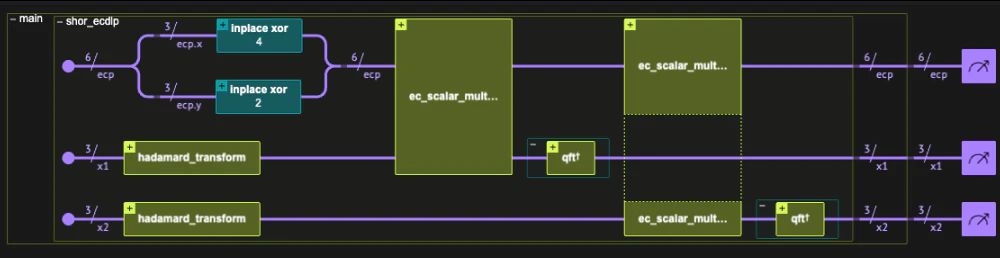
The core of our implementation is the shor_ecdlp quantum function that orchestrates the entire algorithm. It implements the function x1x20x1x2P0+x1Gx2Ptarget.|x_1\rangle|x_2\rangle|0\rangle \rightarrow |x_1\rangle|x_2\rangle| P_0 + x_1 \cdot G - x_2 \cdot P_{target}\rangle.

Expected Quantum Flow

  1. Initialization : All variables start in 0|0\rangle state
  2. State Preparation : Set initial elliptic curve point
  3. Superposition Creation : Apply transformation to create superposition over the possible values of x1x_1 and x2x_2
  4. Quantum Arithmetic : Perform elliptic curve computation P0+x1Gx2PtargetP_0 + x_1 \cdot G - x_2 \cdot P_{target} in superposition
  5. Period Extraction : Apply inverse QFT to extract period information
Quantum Struct Approach: We use a QStruct called EllipticCurvePoint to group the x and y coordinates together, making the code more organized and mathematically intuitive. Quantum Variables:
VariablePurpose
x1First quantum register for period finding (ranges 0-7)
x2Second quantum register for period finding (ranges 0-7)
ecpQuantum elliptic curve point during computation
Classical Parameters:
VariablePurpose
P_0Starting point
GGenerator point
P_targetTarget point
*Note: In this case the order is not a power of
  1. So instead of creating the entire uniform distribution on the x1, x2 variables, we load them with the uniform superposition of only the first #GENERATOR_ORDER states (see the “discrete log” notebook for more examples).*
We do that using the prepare_uniform_trimmed_state library function, which efficiently prepares such a state.
from classiq import *
from classiq.qmod.symbolic import ceiling, log


class EllipticCurvePoint(QStruct):
    x: QNum[CURVE.p.bit_length()]
    y: QNum[CURVE.p.bit_length()]


@qfunc
def shor_ecdlp(
    x1: Output[QNum],  # first quantum variable for period finding
    x2: Output[QNum],  # second quantum variable for period finding
    ecp: Output[
        EllipticCurvePoint
    ],  # third quantum variable for elliptic curve point coordinates
    P_0: list[int],  # starting point - classical
    G: list[int],  # generator point - classical
    P_target: list[int],  # target point - classical
) -> None:
    """
    Main quantum function implementing Shor's algorithm for ECDLP.
    """
    # Step 1: Allocate quantum resources to variables
    var_len = GENERATOR_ORDER.bit_length()
    allocate(var_len, False, var_len, x1)
    allocate(var_len, False, var_len, x2)

    # Step 2: Initialize ecp to P_0
    allocate(ecp)
    ecp.x ^= P_0[0]
    ecp.y ^= P_0[1]

    # Step 3: Create superposition on x1 and x2
    hadamard_transform(x1)
    hadamard_transform(x2)

    # Step 4: Quantum elliptic curve arithmetic in superposition
    # First: ecp = P_0 + x1·G
    ec_scalar_mult_add(ecp, x1, G, CURVE.p, CURVE.a, CURVE.b)

    # Second: ecp = P_0 + x1·G - x2·P_target
    neg_target = [P_target[0], (-P_target[1]) % CURVE.p]
    ec_scalar_mult_add(ecp, x2, neg_target, CURVE.p, CURVE.a, CURVE.b)

    # Step 5: Inverse Quantum Fourier Transform for period extraction
    invert(lambda: qft(x1))
    invert(lambda: qft(x2))

  1. Quantum Elliptic Curve Addition

Algorithm Hierarchy Overview

The shor_ecdlp function orchestrates Shor’s algorithm, but its computational core is the ec_scalar_mult_add function, which performs quantum scalar multiplication in superposition. This function computes the expression P0+kGP_0 + k \cdot G where kk is in quantum superposition, enabling the algorithm to evaluate all possible scalar values simultaneously.

Quantum Scalar Multiplication (ec_scalar_mult_add)

Our implementation uses an efficient hybrid classical-quantum approach. We precompute all the powers-of-two multiples of the base point PP classically: P,2P,4P,8P,,2n1PP, 2P, 4P, 8P, \ldots, 2^{n-1}P. Then we compute the scalar multiple using controlled additions of these precomputed points following the binary representation of the scalar. Algorithm: For scalar k=i=0n1ki2ik = \sum_{i=0}^{n-1} k_i 2^i with ki{0,1}k_i \in \{0, 1\}: kP=i=0n1ki2iP=i=0n1ki(2iP)k \cdot P = \sum_{i=0}^{n-1} k_i 2^i P = \sum_{i=0}^{n-1} k_i (2^i P) Implementation Steps:
  1. Classical Preprocessing: Compute powers P,2P,4P,P, 2P, 4P, \ldots classically
  2. Quantum Control: For each bit kik_i, perform controlled addition of 2iP2^i P to the accumulator
When kk is in superposition k|k\rangle, all possible scalar values are processed simultaneously: k(x,y)k(x,y)+kP|k\rangle|(x,y)\rangle \rightarrow |k\rangle|(x,y) + k \cdot P\rangle All doubling operations happen classically through the ell_double_classical function, leaving only controlled point additions for the in-place elliptic curve point addition quantum function ec_point_add.
@qperm
def ec_scalar_mult_add(
    ecp: EllipticCurvePoint,  # elliptic curve point
    k: QArray[QBit],  # scalar in binary representation (LSB to MSB)
    P: list[int],  # classical point to multiply [x, y]
    p: int,  # prime modulus
    a: int,
    b: int,  # curve parameters
) -> None:
    """
    Quantum scalar multiplication: computes k*P and adds to ecp in-place.
    """
    n = k.size  # Number of bits in scalar k
    current_power = P.copy()  # Start with 1·P = P
    # Process each bit of k from LSB (bit 0) to MSB (bit n-1)
    for i in range(n):
        # Controlled point addition: if k[i] = 1, add current_power to accumulator
        control(k[i], lambda: ec_point_add(ecp, current_power, p))
        # Classical update for next iteration: current_power = 2 * current_power
        if i < n - 1:  # Don't double after the last iteration
            curve = EllipticCurve(p=p, a=a, b=b)
            current_power = ell_double_classical(current_power, curve)

Classical Point Doubling (ell_double_classical)

The doubling of the classically known generator is implemented as follows:
def ell_double_classical(P, curve):
    """
    Classical elliptic curve point doubling for updating powers in ec_scalar_mult_add.

Returns 2P for a point P on the elliptic curve.
    """
    p = curve.p
    x, y = P
    # Slope calculation: s = (3*x² + a) / (2*y) mod p
    numerator = (3 * (x * x % p) + curve.a) % p
    denominator = (2 * y) % p
    s = (numerator * pow(denominator, -1, p)) % p
    # x-coordinate of the result
    xr = (s * s - 2 * x) % p
    # y-coordinate of the result
    yr = (y - s * ((x - xr) % p)) % p
    # Return the result, with y in the standard form
    return [xr, (p - yr) % p]

Quantum Point Addition (ec_point_add)

The ec_point_add function performs the fundamental operation of adding two elliptic curve points in a quantum-reversible manner. Our Implementation Simplification: Following the approach in [1], our implementation focuses only on the generic case where the two points are distinct, not inverses of each other, and neither is the neutral element. These exceptional cases are rare (for large pp) , except when the accumulation register is initialized to the neutral element. Note: *To avoid edge cases (as described above) through the entire quantum scalar multiplication, we chose to initialize the accumulation elliptic curve point with a non-zero point (P0=[4,2]P_0 = [4, 2]) rather than the neutral element. This strategy does not affect the measurement statistics after the Quantum Fourier Transform, since it only adds a global phase to the final quantum state. We deliberately selected a starting point that lies on the elliptic curve but is not within the subgroup generated by GG. Additionally, we exploited the fact that the order of GG is not a power of 2* Disclaimer: This is an engineered example chosen to allow simulation of a small model where edge cases effect the results. In general, such an initialization is not always possible. Algorithm Overview (Generic Case Only):
  1. Input: Quantum point (x1,y1)(x_1, y_1) and classical point G=(Gx,Gy)G = (G_x, G_y)
  2. Slope calculation: Compute λ=y1Gyx1Gx(modp)\lambda = \frac{y_1 - G_y}{x_1 - G_x} \pmod{p} using quantum modular inverse
  3. Result coordinates:
  • xresult:=x3=λ2x1Gx(modp)x_{result}:= x_3 = \lambda^2 - x_1 - G_x \pmod{p}
  • yresult:=y3=λ(x1x3)y1(modp)y_{result}:= y_3 = \lambda(x_1 - x_3) - y_1 \pmod{p}
  1. Cleanup: Uncompute auxiliary values to maintain reversibility
Reference: The ec_point_add function is based on Algorithm 1 from “Quantum resource estimates for computing elliptic curve discrete logarithms” by Roetteler et al. (2017) [1] To implement ec_point_add, we need a complete library of reversible modular arithmetic operations which we import directly from the Classiq open library.

Modular Arithmetic Functions imported from Classiq Open Library

  • Organized by Category:
Basic Modular Operations:
  • modular_add_inplace
  • Modular addition
  • modular_negate_inplace
  • Modular negation
  • modular_subtract_inplace
  • Modular subtraction
Constant Operations:
  • modular_add_constant_inplace
  • Modular addition of a classical constant
Multiplication Operations:
  • modular_multiply
  • Modular multiplication
  • modular_square
  • Modular squaring
In our example, we will first implement modular inversion using a mock quantum function mock_modular_inverse based on a classical lookup table specifically for modulo 7, instead of implementing the full quantum modular inversion function modular_inverse_inplace (based on “Kaliski’s algorithm”), which requires significant qubit resources. *The above choice is driven by the practical desire to first fully simulate the entire elliptic curve discrete logarithm (ECDLP) algorithm flow within the limits of currently available quantum simulators. The full ECDLP synthesized circuit (including the full modular_inverse_inplace implementation) is presented at the end of this notebook.*
import math

from classiq.qmod.symbolic import subscript


@qperm
def mock_modular_inverse(x: Const[QNum], result: QNum, modulus: int) -> None:
    """
    Performs the transformation |x>|0> → |x>|x^(-1) mod modulus> for x in 1..modulus-

1. This is a mock implementation using controlled operations based on lookup table values.
    If the modular inverse does not exist, sets the 2nd register to 

0.
    """
    # Generate the lookup table for modular inverses
    inverse_table = lookup_table(
        lambda _x: pow(_x, -1, modulus) if math.gcd(_x, modulus) == 1 else 0, x
    )
    result ^= subscript(inverse_table, x)

@qperm
def ec_point_add(
    ecp: EllipticCurvePoint,
    G: list[int],  # Classical point coordinates [Gx, Gy] on the curve
    p: int,  # Prime modulus
) -> None:
    """
    Performs in-place elliptic curve point addition of a point whose coordinates are
    stored in quantum struct object and a classically known point.
    """

    n = CURVE.p.bit_length()
    slope = QNum()  # aux quantum register for lambda (slope)
    allocate(n, slope)
    t0 = QNum()  # aux quantum register for internal arithmetic
    allocate(n, t0)

    # Extract classical coordinates
    Gx = G[0]  # x2
    Gy = G[1]  # y2

    # Step 1: # y <-- (y1 - y2) mod p
    modular_add_constant_inplace(p, (-Gy) % p, ecp.y)

    # Step 2: # x <-- (x1 - x2) mod p
    modular_add_constant_inplace(p, (-Gx) % p, ecp.x)

    # Step 3: # λ <-- (y1 - y2) / (x1 - x2) mod p
    within_apply(
        lambda: mock_modular_inverse(ecp.x, t0, p),  # t0 <-- (x1 - x2)^(-1) mod p
        lambda: modular_multiply(p, t0, ecp.y, slope),  #  λ <-- t0 * (y1 -y2)
    )

    # Step 4: y <-- 0
    within_apply(
        lambda: modular_multiply(
            p, slope, ecp.x, t0
        ),  # t0 <-- λ * (x1 -x2) = (y1 - y2) = y
        lambda: inplace_xor(t0, ecp.y),  # y <-- 0
    )

    # Step 5: x <-- x2 - x3
    within_apply(
        lambda: modular_square(p, slope, t0),  # t0 = λ²
        lambda: (
            modular_subtract_inplace(p, t0, ecp.x),  # x <-- t0 - x = λ² - (x1 - x2)
            modular_negate_inplace(p, ecp.x),  # x <-- -x  = x1 - x2 - λ²
            modular_add_constant_inplace(
                p, (3 * Gx) % p, ecp.x
            ),  # x <-- x1 - x2 - λ² + 3*x2 = x2 - x3
        ),
    )

    # Step 6: y <-- y3 + y2
    modular_multiply(p, slope, ecp.x, ecp.y)  # y = λ * (x2 - x3) = y3 + y2

    # Step 7: λ <-- 0
    t1 = QNum()  # aux quantum register for manually uncomputing the slope
    within_apply(
        lambda: mock_modular_inverse(ecp.x, t0, p),  # t0 <-- (x2 - x3)^(-1)
        lambda: within_apply(
            lambda: (
                allocate(CURVE.p.bit_length(), t1),
                modular_multiply(p, t0, ecp.y, t1),  # t1 <-- (y3 + y2)/(x2 - x3) = λ
            ),
            lambda: inplace_xor(t1, slope),  #  λ <-- 0
        ),
    )
    free(slope)

    # Step 8: Final coordinate adjustments
    modular_add_constant_inplace(p, (-Gy) % p, ecp.y)  # y <-- y3 + y2 - y2 = y3!
    modular_negate_inplace(p, ecp.x)  # x <-- x3 - x2
    modular_add_constant_inplace(p, Gx, ecp.x)  # x <-- x3 - x2 + x2 = x3!
Note: To enable reversible in-place point addition, the slope λ\lambda can be recomputed (as can be observed from step 6 in ec_point_add) from the output point P3P_3 and the known input P2P_2 using the identity: y1y2x1x2=y3+y2x3x2\frac{y_1 - y_2}{x_1 - x_2} = -\frac{y_3 + y_2}{x_3 - x_2} This ensures that P1P_1 can be safely overwritten with P3P_3 while still allowing recovery of λ\lambda for uncomputing it.

Step-by-Step Point Addition Example

Let’s see how elliptic curve point addition actually works by computing [4,2]+[0,5][4, 2] + [0, 5]: Step 1: Calculate the slope For two distinct points P1=(x1,y1)=(4,2)P_1 = (x_1, y_1) = (4, 2) and P2=(x2,y2)=(0,5)P_2 = (x_2, y_2) = (0, 5): λ=y2y1x2x1=5204=34=33=1(mod7)\lambda = \frac{y_2 - y_1}{x_2 - x_1} = \frac{5 - 2}{0 - 4} = \frac{3}{-4} = \frac{3}{3} = 1 \pmod{7} Note: 43(mod7)-4 \equiv 3 \pmod{7}, and 315(mod7)3^{-1} \equiv 5 \pmod{7} since 3×5=151(mod7)3 \times 5 = 15 \equiv 1 \pmod{7} Actually: λ=3×5=151(mod7)\lambda = 3 \times 5 = 15 \equiv 1 \pmod{7} Step 2: Calculate the x-coordinate of the result x3=λ2x1x2=1240=14=34(mod7)x_3 = \lambda^2 - x_1 - x_2 = 1^2 - 4 - 0 = 1 - 4 = -3 \equiv 4 \pmod{7} Step 3: Calculate the y-coordinate of the result y3=λ(x1x3)y1=1×(44)2=02=25(mod7)y_3 = \lambda(x_1 - x_3) - y_1 = 1 \times (4 - 4) - 2 = 0 - 2 = -2 \equiv 5 \pmod{7} Result: [4,2]+[0,5]=[4,5][4, 2] + [0, 5] = [4, 5] Lets apply ec_point_add to add P1P_1 and P2P_2:
# Define the specific points from the notebook example
P1 = [4, 2]  # Starting quantum point (will be modified in-place)
P2 = [0, 5]  # Classical point to add
expected_result = [4, 5]


@qfunc
def main(
    ecp: Output[EllipticCurvePoint],
) -> None:
    """Main quantum function for testing ec_point_add"""
    # Initialize elliptic curve point with P1 coordinates
    allocate(ecp)
    ecp.x ^= P1[0]  # x = 4
    ecp.y ^= P1[1]  # y = 2

    # Perform point addition: ecp = P1 + P2 = [4, 2] + [0, 5]
    ec_point_add(ecp, P2, CURVE.p)


# Set up optimization constraints
constraints = Constraints(optimization_parameter="width")
preferences = Preferences(optimization_level=1, qasm3=True)

# Create and synthesize quantum model
qmod = create_model(main, constraints=constraints, preferences=preferences)

print("Synthesizing quantum circuit for ec_point_add...")
qprog_point_add = synthesize(qmod)

# Display circuit information
print(f"Number of qubits: {qprog_point_add.data.width}")
print(f"Program depth: {qprog_point_add.transpiled_circuit.depth}")
show(qprog_point_add)

# Execute the quantum circuit
print("Executing quantum circuit...")
result = execute(qprog_point_add).result()
print("Execution complete.")
Output:

Synthesizing quantum circuit for ec_point_add...

Number of qubits: 17
  Program depth: 10928
  Quantum program link: https://platform.classiq.io/circuit/37HaGh1CUEPeQILCn6CknGWMziX
  Executing quantum circuit...

Execution complete.
  

# Extract quantum results
quantum_results = result[0].value.parsed_counts[0].state
ec_point_result = [quantum_results["ecp"]["x"], quantum_results["ecp"]["y"]]
# Verify the result
assert len(quantum_results)
assert ec_point_result == expected_result
print(f"Quantum result matches expected manual calculation!")
print(f"Verified: [4, 2] + [0, 5] = [4, 5] on curve y² = x³ + 5x + 4 (mod 7)")
Output:

Quantum result matches expected manual calculation!
  Verified: [4, 2] + [0, 5] = [4, 5] on curve y² = x³ + 5x + 4 (mod 7)
  

  1. Execute the Entire Algorithm Flow
We are now ready to synthesize and execute the complete Shor’s ECDLP algorithm implemented with the shor_ecdlp function.

Main function

@qfunc
def main(x1: Output[QNum], x2: Output[QNum], ecp: Output[EllipticCurvePoint]) -> None:
    # Call shor_ecdlp with the required parameters
    shor_ecdlp(x1, x2, ecp, INITIAL_POINT, GENERATOR_G, TARGET_POINT)
Screenshot 2025-08-21 at 17.31.09.png

Model creation and synthesis

print("Creating model for Shor's ECDLP algorithm...")

constraints = Constraints(optimization_parameter="width")
preferences = Preferences(timeout_seconds=3600, optimization_level=1, qasm3=True)
qmod = create_model(main, constraints=constraints, preferences=preferences)
write_qmod(qmod, "elliptic_curve_discrete_log", symbolic_only=False)

print("Synthesizing quantum program...")
qprog_shor_ecdlp = synthesize(qmod)

# Display circuit metrics
num_qubits = qprog_shor_ecdlp.data.width
print(f"Number of qubits: {num_qubits}")
show(qprog_shor_ecdlp)
Output:

Creating model for Shor's ECDLP algorithm...

Synthesizing quantum program...

Number of qubits: 23
  Quantum program link: https://platform.classiq.io/circuit/37HabpslsbIKZQA1k1zxki4eiGL
  

Quantum Program Analysis

We can analyze the transpiled circuit characteristics from the quantum program object:
qprog_shor_ecdlp.transpiled_circuit.count_ops
Output:
{'cx': 60828,
   'p': 44368,
   'u': 19619,
   'rz': 4104,
   'h': 3301,
   'tdg': 2844,
   't': 2844,
   'u1': 792,
   'x': 458}
  

qprog_shor_ecdlp.transpiled_circuit.depth
Output:
80093
  

Execution

res = execute(qprog_shor_ecdlp).result_value()

Results Collection

df = res.dataframe
df_sorted = df.sort_values("counts", ascending=False)
df_sorted["probability"] = df_sorted["counts"] / df["counts"].sum()

print(f"\nQuantum Execution Results:")
print(f"Total distinct pairs: {len(df)}, Total measurements: {df['counts'].sum()}")
print("\nTop 10 results:")
print(df_sorted.head(10))
Output:

Quantum Execution Results:
  Total distinct pairs: 221, Total measurements: 2048

  Top 10 results:
        x1     x2  ecp.x  ecp.y  count  probability     bitstring
  0  0.000  0.000      3      2    100     0.048828  010011000000
  1  0.000  0.000      5      0     95     0.046387  000101000000
  2  0.375  0.375      3      2     87     0.042480  010011011011
  3  0.625  0.625      3      2     83     0.040527  010011101101
  4  0.000  0.000      4      5     82     0.040039  101100000000
  5  0.625  0.625      5      0     77     0.037598  000101101101
  6  0.375  0.375      5      0     71     0.034668  000101011011
  7  0.000  0.000      4      2     71     0.034668  010100000000
  8  0.000  0.000      3      5     69     0.033691  101011000000
  9  0.625  0.625      3      5     61     0.029785  101011101101
  

  1. Post-Processing Results
For post-processing our results, we will follow the same logic as explained in the “discrete log” notebook. We translate each result to the closest fraction with a denominator, which is the order:
def closest_fraction(x, denominator):
    return round(x * denominator)


df_sorted["x1_rounded"] = closest_fraction(df_sorted.x1, GENERATOR_ORDER)
df_sorted["x2_rounded"] = closest_fraction(df_sorted.x2, GENERATOR_ORDER)
df_sorted.head(10)
x1x2ecp.xecp.ycountprobabilitybitstringx1_roundedx2_rounded
00.0000.000321000.0488280100110000000.00.0
10.0000.00050950.0463870001010000000.00.0
20.3750.37532870.0424800100110110112.02.0
30.6250.62532830.0405270100111011013.03.0
40.0000.00045820.0400391011000000000.00.0
50.6250.62550770.0375980001011011013.03.0
60.3750.37550710.0346680001010110112.02.0
70.0000.00042710.0346680101000000000.00.0
80.0000.00035690.0336911010110000000.00.0
90.6250.62535610.0297851010111011013.03.0
Now, we take a sample where x2 is co-prime to the order, such that we can get the logarithm by multiplying x1 by the modular inverse. If the x1, x2 registers are large enough, we are guaranteed to sample it with a good probability. From the valid solutions, we solve for the discrete logarithm using: logarithm=x1x21modr\text{logarithm} = - x_1 \cdot x_2^{-1} \bmod r
import numpy as np


def modular_inverse(x):
    return [pow(a, -1, GENERATOR_ORDER) for a in x]


df_sorted = df_sorted[
    np.gcd(df_sorted.x2_rounded.astype(int), GENERATOR_ORDER) == 1
].copy()
df_sorted["x2_inverse"] = modular_inverse(df_sorted.x2_rounded.astype("int"))
df_sorted["logarithm"] = -df_sorted.x1_rounded * df_sorted.x2_inverse % GENERATOR_ORDER
df_sorted.head(10)
x1x2ecp.xecp.ycountprobabilitybitstringx1_roundedx2_roundedx2_inverselogarithm
20.3750.37532870.0424800100110110112.02.034.0
30.6250.62532830.0405270100111011013.03.024.0
50.6250.62550770.0375980001011011013.03.024.0
60.3750.37550710.0346680001010110112.02.034.0
90.6250.62535610.0297851010111011013.03.024.0
100.3750.37545590.0288091011000110112.02.034.0
110.6250.62545590.0288091011001011013.03.024.0
120.3750.37535580.0283201010110110112.02.034.0
130.3750.37542560.0273440101000110112.02.034.0
140.6250.62542520.0253910101001011013.03.024.0
assert len(df_sorted.logarithm) > 0
assert np.allclose(df_sorted.logarithm[:10], 4)

Quantum Algorithm Success

The fact that multiple valid pairs yield the same discrete logarithm (l = 4) confirms the quantum algorithm worked correctly, extracting the hidden period structure from Shor’s algorithm.

  1. The Full Quantum Elliptic Curve Addition Quantum Program
Now that we successfully verified the full ECDLP flow we can synthesize and analyze the full implementation of ec_point_add using the quantum modular inversion function modular_inverse_inplace (based on “Kaliski’s algorithm”) - imported directly from the Classiq Open Library.
@qperm
def ec_point_add(
    ecp: EllipticCurvePoint,
    G: list[int],  # Classical point coordinates [Gx, Gy] on the curve
    p: int,  # Prime modulus
) -> None:
    """
    Performs in-place elliptic curve point addition of a point whose coordinates are
    stored in quantum struct object and a classically known point.
    """

    slope = QNum()  # aux quantum register for lambda (slope)
    allocate(CURVE.p.bit_length(), slope)
    t0 = QNum()  # aux quantum register for internal arithmetic
    allocate(CURVE.p.bit_length(), t0)
    m = QArray()

    # Extract classical coordinates
    Gx = G[0]  # x2
    Gy = G[1]  # y2

    # Step 1: # y <-- (y1 - y2) mod p
    modular_add_constant_inplace(p, (-Gy) % p, ecp.y)

    # Step 2: # x <-- (x1 - x2) mod p
    modular_add_constant_inplace(p, (-Gx) % p, ecp.x)

    # Step 3: # λ <-- (y1 - y2) / (x1 - x2) mod p
    within_apply(
        lambda: modular_inverse_inplace(p, ecp.x, m),  # t0 <-- (x1 - x2)^(-1) mod p
        lambda: modular_multiply(p, ecp.x, ecp.y, slope),  #  λ <-- t0 * (y1 -y2)
    )
    # free(m)

    # Step 4: y <-- 0
    within_apply(
        lambda: modular_multiply(
            p, slope, ecp.x, t0
        ),  # t0 <-- λ * (x1 -x2) = (y1 - y2) = y
        lambda: inplace_xor(t0, ecp.y),  # y <-- 0
    )

    # Step 5: x <-- x2 - x3
    within_apply(
        lambda: modular_square(p, slope, t0),  # t0 = λ²
        lambda: (
            modular_subtract_inplace(p, t0, ecp.x),  # x <-- t0 - x = λ² - (x1 - x2)
            modular_negate_inplace(p, ecp.x),  # x <-- -x  = x1 - x2 - λ²
            modular_add_constant_inplace(
                p, (3 * Gx) % p, ecp.x
            ),  # x <-- x1 - x2 - λ² + 3*x2 = x2 - x3
        ),
    )

    # Step 6: y <-- y3 + y2
    modular_multiply(p, slope, ecp.x, ecp.y)  # y = λ * (x2 - x3) = y3 + y2

    # Step 7: λ <-- 0
    t1 = QNum()  # aux quantum register for manually uncomputing the slope
    within_apply(
        lambda: modular_inverse_inplace(p, ecp.x, m),  # t0 <-- (x2 - x3)^(-1)
        lambda: within_apply(
            lambda: (
                allocate(CURVE.p.bit_length(), t1),
                modular_multiply(p, ecp.x, ecp.y, t1),  # t1 <-- (y3 + y2)/(x2 - x3) = λ
            ),
            lambda: inplace_xor(t1, slope),  #  λ <-- 0
        ),
    )
    free(slope)

    # Step 8: Final coordinate adjustments
    modular_add_constant_inplace(p, (-Gy) % p, ecp.y)  # y <-- y3 + y2 - y2 = y3!
    modular_negate_inplace(p, ecp.x)  # x <-- x3 - x2
    modular_add_constant_inplace(p, Gx, ecp.x)  # x <-- x3 - x2 + x2 = x3!

    free(t0)

# Define the specific points from the notebook example
P1 = [4, 2]  # Starting quantum point (will be modified in-place)
P2 = [0, 5]  # Classical point to add
expected_result = [4, 5]


@qfunc
def main(
    ecp: Output[EllipticCurvePoint],
) -> None:
    """Main quantum function for testing ec_point_add"""
    # Initialize elliptic curve point with P1 coordinates
    allocate(ecp)
    ecp.x ^= P1[0]  # x = 4
    ecp.y ^= P1[1]  # y = 2

    # Perform point addition: ecp = P1 + P2 = [4, 2] + [0, 5]
    ec_point_add(ecp, P2, CURVE.p)


# Set up optimization constraints
constraints = Constraints(optimization_parameter="width")
preferences = Preferences(timeout_seconds=3600, optimization_level=1, qasm3=True)

# Create and synthesize quantum model
qmod = create_model(main, constraints=constraints, preferences=preferences)

print("Synthesizing quantum circuit for ec_point_add...")
qprog_point_add_full = synthesize(qmod)

# Display circuit information
print(f"Number of qubits: {qprog_point_add_full.data.width}")
print(f"Program depth: {qprog_point_add_full.transpiled_circuit.depth}")
show(qprog_point_add_full)
Output:

Synthesizing quantum circuit for ec_point_add...

Number of qubits: 34
  Program depth: 52180
  Quantum program link: https://platform.classiq.io/circuit/37HdFbVHmK50VrFETZnFPpjwiEU
  

  1. The Full ECDLP Quantum Program
This section presents the complete synthesis of Shor’s ECDLP algorithm using the full quantum modular arithmetic library, demonstrating the end-to-end quantum circuit that solves the elliptic curve discrete logarithm problem with all components implemented using the Classiq Open Library functions.
@qfunc
def main(x1: Output[QNum], x2: Output[QNum], ecp: Output[EllipticCurvePoint]) -> None:
    # Call shor_ecdlp with the required parameters
    shor_ecdlp(x1, x2, ecp, INITIAL_POINT, GENERATOR_G, TARGET_POINT)

print("Creating model for Shor's ECDLP algorithm...")

constraints = Constraints(optimization_parameter="width")
preferences = Preferences(timeout_seconds=3600, optimization_level=1, qasm3=True)

print("Synthesizing quantum program...")
qprog_shor_ecdlp_full = synthesize(
    main, constraints=constraints, preferences=preferences
)

# Display circuit metrics
print(f"Number of qubits: {qprog_shor_ecdlp_full.data.width}")
print(f"Program depth: {qprog_shor_ecdlp_full.transpiled_circuit.depth}")

show(qprog_shor_ecdlp_full)
Output:

Creating model for Shor's ECDLP algorithm...

Synthesizing quantum program...

Number of qubits: 40
  Program depth: 326809
  Quantum program link: https://platform.classiq.io/circuit/37HgZ8JOkfm2KeURploTQnYGt36
  

Algorithm Complexity and Quantum Advantage

Classical Complexity: The best known classical algorithms for ECDLP (such as Pollard’s rho algorithm) require O(n)O(\sqrt{n}) operations, where nn is the order of the elliptic curve group. For cryptographically relevant curves with 256-bit keys, this means approximately 21282^{128} operations. Quantum Complexity: Shor’s algorithm reduces this to O((logn)3)O((\log n)^3) operations using O(logn)O(\log n) qubits, providing an exponential speedup. For the same 256-bit curves, this reduces to approximately 2242^{24} operations.

References

[1]: Martin Roetteler, Michael Naehrig, Krysta M. Svore, and Kristin Lauter. “Quantum resource estimates for computing elliptic curve discrete logarithms.” arXiv preprint arXiv:1706.06752 (2017). [2]: Peter W. Shor. “Polynomial-time algorithms for prime factorization and discrete logarithms on a quantum computer.” SIAM Journal on Computing, 26(5):1484-1509 (1997).