> ## Documentation Index
> Fetch the complete documentation index at: https://docs.classiq.io/llms.txt
> Use this file to discover all available pages before exploring further.
# Data Analysis and Graphs
The input to the analyzer tool is a quantum program in OpenQasm or Cirq format.
The analysis data and graphs can be accessed using Classiq's Python
SDK.
After synthesizing a quantum program, initialize the `Analyzer` class using the quantum program
returned from the synthesis process.
[comment]: DO_NOT_TEST
```python theme={null}
from classiq import (
qfunc,
Analyzer,
Output,
QBit,
allocate,
synthesize,
QuantumProgram,
allocate,
)
@qfunc
def main(res: Output[QBit]) -> None:
allocate(1, res)
qprog = synthesize(main)
analyzer = Analyzer(circuit=qprog)
```
## Graphs and Data
Quantum programs are more than just a beautiful image; they are meant to run on
real quantum hardware to solve and supply interesting and new answers.
The hardware analysis supplies two main insights.
### Available Devices
To perform hardware-aware analysis, you may want to know which devices are
available using the
platform. You can get a list of the devices that are both available and
suit the quantum program (i.e., have a sufficient number of qubits).
[comment]: DO_NOT_TEST
```python theme={null}
analyzer.get_available_devices()
```
This command returns the available devices of all the providers, in dictionary
format, where providers are
the keys, and lists of available devices are the values:
[comment]: DO_NOT_TEST
```python theme={null}
{
"IBM Quantum": [
"almaden",
"boeblingen",
"brooklyn",
"cairo",
"cambridge",
"guadalupe",
"hanoi",
"johannesburg",
"kolkata",
"manhattan",
"melbourne",
"montreal",
"mumbai",
"paris",
"poughkeepsie",
"rochester",
"rueschlikon",
"singapore",
"sydney",
"tokyo",
"toronto",
"washington",
],
"Azure Quantum": ["ionq", "quantinuum"],
}
```
You can also request the devices of a specific provider:
[comment]: DO_NOT_TEST
```python theme={null}
analyzer.get_available_devices(["IBM Quantum"])
```
### Hardware-Circuit Connection
The Hardware-Circuit Connection graph is a representation of a quantum program as
implemented on a specific (physical) quantum device. You
can interactively select hardware from hardware providers such as IBM Quantum,
Amazon Braket, and Microsoft Azure.
The analyzer compiles the quantum program for the selected hardware, allowing easy
inspection of which physical qubits will be used for execution on the device
and, in turn, modifying the quantum program if needed.
This information is important if you want to execute the quantum program on real quantum
hardware, so you can make modifications to the quantum program.
This graph is accessible from the SDK only if you install the `analyzer_sdk`
extension with the
`pip install classiq[analyzer_sdk]` command and use Jupyter as your coding
platform. Once the extension is installed, run this command:
[comment]: DO_NOT_TEST
```python theme={null}
# Run inside jupyter
analyzer.plot_hardware_connectivity()
```
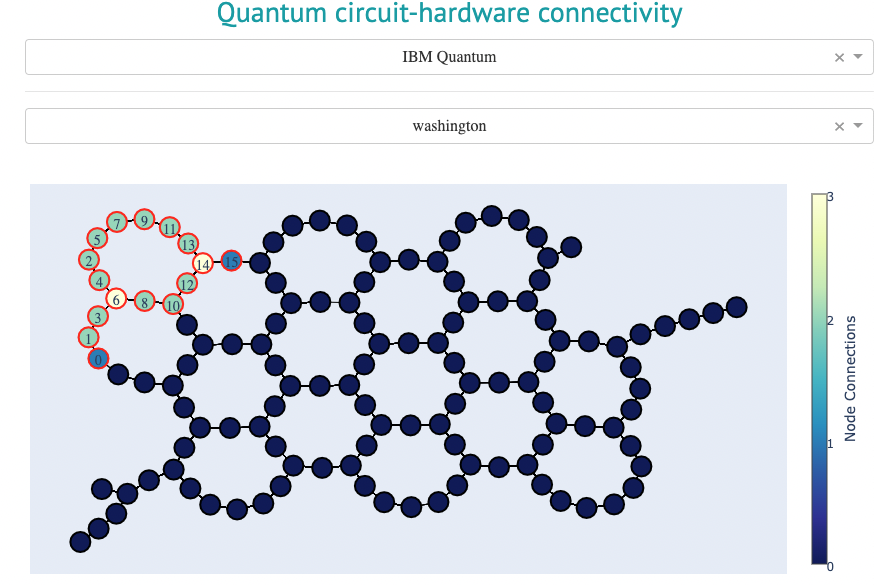 Alternatively, you can open the graph directly with a specific provider and
device:
[comment]: DO_NOT_TEST
```python theme={null}
analyzer.plot_hardware_connectivity(provider="IBM Quantum", device="washington")
```
### Hardware Comparison Table
The hardware comparison table compares the transpiled quantum program on different
hardware backends. The table includes information about the quantum program's depth, number of
multi-qubit gates, and total number of gates.
[comment]: DO_NOT_TEST
```python theme={null}
providers = ["IBM Quantum", "Azure Quantum", "Amazon Braket"]
analyzer = Analyzer(circuit=qprog)
analyzer.get_hardware_comparison_table(providers=providers)
analyzer.plot_hardware_comparison_table()
```
The `providers` variable is a list of providers ("IBM Quantum", "Azure Quantum",
and "Amazon Braket"), where the table includes only the backends of providers that
appear in the list, and the default is to use all the providers.
The table has the following form:
Alternatively, you can open the graph directly with a specific provider and
device:
[comment]: DO_NOT_TEST
```python theme={null}
analyzer.plot_hardware_connectivity(provider="IBM Quantum", device="washington")
```
### Hardware Comparison Table
The hardware comparison table compares the transpiled quantum program on different
hardware backends. The table includes information about the quantum program's depth, number of
multi-qubit gates, and total number of gates.
[comment]: DO_NOT_TEST
```python theme={null}
providers = ["IBM Quantum", "Azure Quantum", "Amazon Braket"]
analyzer = Analyzer(circuit=qprog)
analyzer.get_hardware_comparison_table(providers=providers)
analyzer.plot_hardware_comparison_table()
```
The `providers` variable is a list of providers ("IBM Quantum", "Azure Quantum",
and "Amazon Braket"), where the table includes only the backends of providers that
appear in the list, and the default is to use all the providers.
The table has the following form:
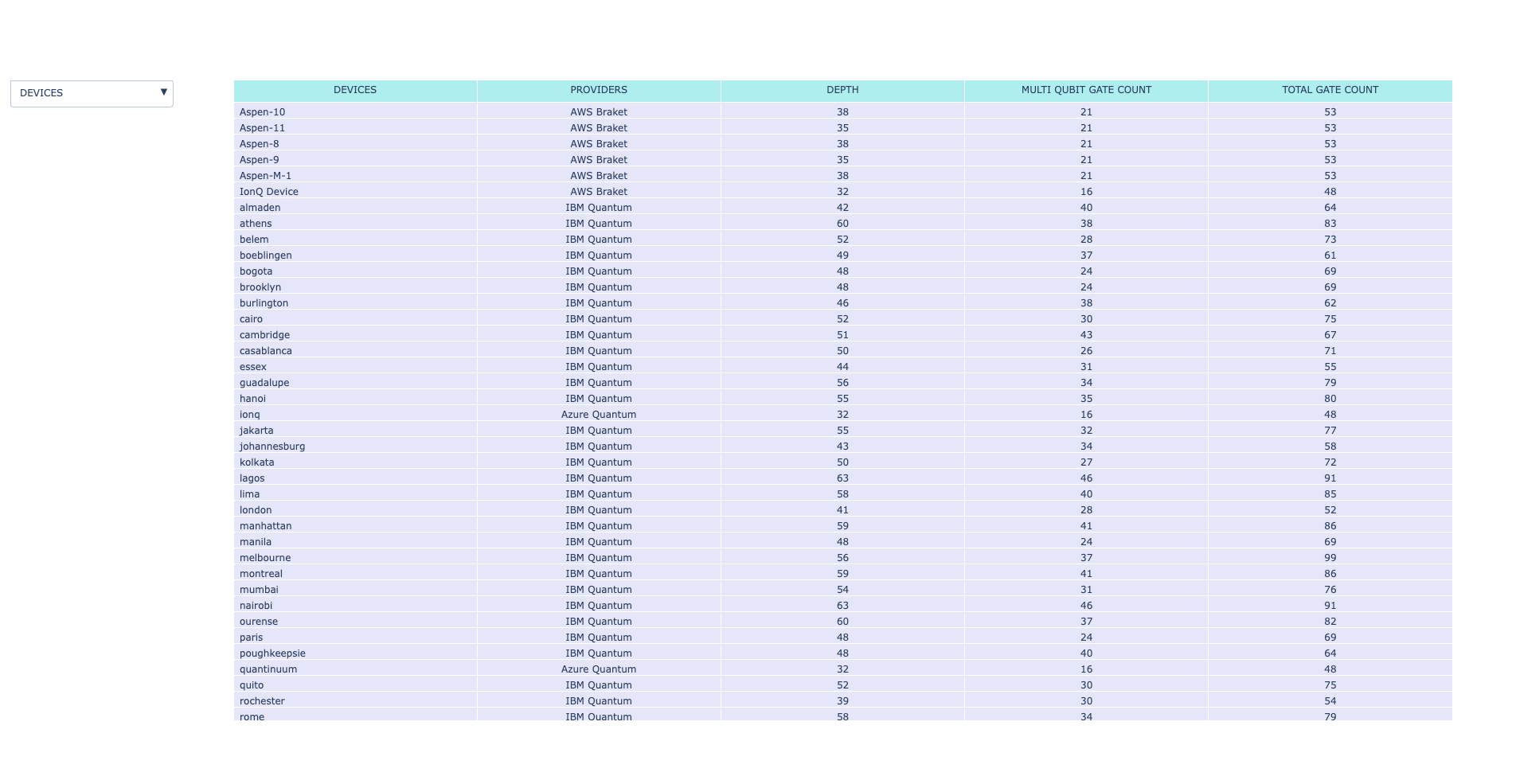 Sort the table according to the table properties using the dropdown button on
the upper left of the table. \`\`\`
Using the default device/providers option (all) or comparing a large
number of devices might take a long time, especially when analyzing large quantum programs.
It is advised to compare a small number of devices when you are interested in analyzing large quantum programs.
The difference between the transpilation in the synthesis process and the comparison table data originates from the fact that the comparison table data is aware of the specific hardware and considers information such as the basis gates and connectivity.
\[1] M. Van den Nest, W. Dur, G. Vidal, H. J. Briegel,
"Classical simulation versus universality in measurement-based quantum
computation",
Phys. Rev. A 75, 012337 (2007).
\[2] S. Oum,
"Rank-width: Algorithmic and structural results", Lect. Notes Comput. Sci. 3787,
49 (2005).
\[3] S. Oum,
"Rank-width is less than or equal to branch-width", J. Graph Theory, 57 (3),
239-244 (2008).
\[4] Hans L. Bodlaender, "Discovering treewidth".
Institute of
Information and Computing Sciences, Utrecht University, Technical Report.
UU-CS-2005-018.
[http://www.cs.uu.nl](http://www.cs.uu.nl)
Sort the table according to the table properties using the dropdown button on
the upper left of the table. \`\`\`
Using the default device/providers option (all) or comparing a large
number of devices might take a long time, especially when analyzing large quantum programs.
It is advised to compare a small number of devices when you are interested in analyzing large quantum programs.
The difference between the transpilation in the synthesis process and the comparison table data originates from the fact that the comparison table data is aware of the specific hardware and considers information such as the basis gates and connectivity.
\[1] M. Van den Nest, W. Dur, G. Vidal, H. J. Briegel,
"Classical simulation versus universality in measurement-based quantum
computation",
Phys. Rev. A 75, 012337 (2007).
\[2] S. Oum,
"Rank-width: Algorithmic and structural results", Lect. Notes Comput. Sci. 3787,
49 (2005).
\[3] S. Oum,
"Rank-width is less than or equal to branch-width", J. Graph Theory, 57 (3),
239-244 (2008).
\[4] Hans L. Bodlaender, "Discovering treewidth".
Institute of
Information and Computing Sciences, Utrecht University, Technical Report.
UU-CS-2005-018.
[http://www.cs.uu.nl](http://www.cs.uu.nl)