> ## Documentation Index
> Fetch the complete documentation index at: https://docs.classiq.io/llms.txt
> Use this file to discover all available pages before exploring further.
# Oracle generation for 3-SAT problems
Open this notebook in GitHub to run it yourself
This notebook demonstrates Classiq's capabilities in the framework of phase oracles.
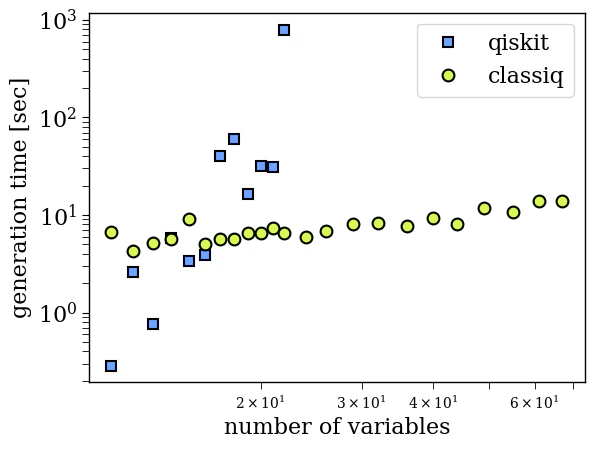
The focus is 3-SAT problems on a growing number of variables. To highlight the advantage of generation times, we skip transpilation for the synthesis output.
The following utility functions generate random 3-SAT problems for $N$ boolean variables, consisting of $N$ clauses.
```python theme={null}
import numpy as np
from classiq.qmod.symbolic import logical_and, logical_not, logical_or
def generate_permutation_for_3sat_expression(num_qubits, max_samples=1000):
"""
A function that generates two permutations on a list of num_qubits variables,
for introducing a random and valid 3-SAT problem
"""
direct_arr = np.array([k for k in range(num_qubits)])
for k in range(max_samples):
permut1 = np.random.permutation(num_qubits)
permut2 = np.random.permutation(num_qubits)
if (
(0 not in permut2 - direct_arr)
and (0 not in permut1 - direct_arr)
and (0 not in permut1 - permut2)
):
break
assert (
k < max_samples
), "Could not find a random 3-SAT problem, try to increase max_samples"
return direct_arr, permut1, permut2
def generate_3sat_qbit_expression(vars, s0, s1, s2):
"""
A function that generates a 3-SAT problem on a list of QBit variables.
The returned expression contains num_qubits=len(vars) clauses and contains
triplets of the form (x_k or ~x_s1(k) or x_s2(k)), where s1, s2 are permutations.
"""
num_qubits = len(vars)
k = 0
y = logical_or(logical_or(vars[s0[k]], logical_not(vars[s1[k]])), vars[s2[k]])
for k in range(1, num_qubits):
temp = logical_or(
logical_or(vars[s0[k]], logical_not(vars[s1[k]])), vars[s2[k]]
)
y = logical_and(y, temp)
return y
```
##
1. Generating Phase Oracles
For each 3-SAT problem we generate an oracle with Classiq and save the generation time, as well as the circuits' width.
```python theme={null}
from classiq import *
qmods = []
qprogs = []
def get_generation_time_classiq(s0, s1, s2, num_qubits):
start_cl = time.time()
@qfunc
def main(qbv: Output[QArray]):
def inner_call(aux: QNum):
aux ^= generate_3sat_qbit_expression(
[qbv[k] for k in range(num_qubits)], s0, s1, s2
)
allocate(num_qubits, qbv)
aux = QNum("aux")
allocate(1, aux)
within_apply(
lambda: (X(aux), H(aux)),
lambda: inner_call(aux),
)
free(aux)
qmod = create_model(main)
qmod = set_preferences(qmod, preferences=Preferences(transpilation_option="none"))
qmods.append(qmod)
qprog = synthesize(qmod)
qprogs.append(qprog)
return qprog.data.width, time.time() - start_cl
```
The following function generates a phase oracle with qiskit.
```python theme={null}
def get_generation_time_qiskit(s0, s1, s2, num_qubits):
start_qs = time.time()
dict_of_qnums = {f"x{k}": QNum(f"x{k}") for k in range(num_qubits)}
expression = str(
generate_3sat_qbit_expression(
[dict_of_qnums[f"x{k}"] for k in range(num_qubits)], s0, s1, s2
)
)
expression = expression.replace("or", "|")
expression = expression.replace("not", "~")
expression = expression.replace("and", "&")
oracle = PhaseOracle(expression, var_order=None)
q = QuantumRegister(num_qubits)
qc = QuantumCircuit(q)
qc.append(oracle, q[:])
return time.time() - start_qs
```
*For generating the same data with Qiskit please uncomment the commented lines (including the `pip install command`).* We work with qiskit version 1.0.
0.
```python theme={null}
import time
from qiskit import QuantumCircuit, QuantumRegister, transpile
from qiskit.circuit.library import PhaseOracle
```
We skip generating data with Qiskit for $N>23$, as generation times exponentially diverge with the number of variables.
```python theme={null}
np.random.seed(128)
cl_times = []
num_qubits_list = [k for k in range(11, 23)] + [
int(l) for l in np.logspace(np.log2(24), np.log2(68), 11, base=2)
]
```
```python theme={null}
# from importlib.metadata import version
# try:
# import qiskit
# if version('qiskit') != "1.0.0":
# !pip uninstall qiskit -y
# !pip install qiskit==1.0.0
# except ImportError:
# !pip install qiskit==1.0.0
# ! pip install tweedledum
# qs_times = []
```
```python theme={null}
for l in num_qubits_list:
num_qubits = l
print("num_qubits:", num_qubits)
s0, s1, s2 = generate_permutation_for_3sat_expression(num_qubits)
cl_width, classiq_generation_time = get_generation_time_classiq(
s0, s1, s2, num_qubits
)
cl_times.append(classiq_generation_time)
print("classiq_width:", cl_width, ", classiq_time:", classiq_generation_time)
# if l<23:
# qiskit_generation_time = get_generation_time_qiskit(s0, s1, s2, num_qubits)
# qs_times.append(qiskit_generation_time)
# print("qiskit_time:", qiskit_generation_time)
```
**Output:**
```
num_qubits: 11
classiq_width: 25 , classiq_time: 6.707828998565674
num_qubits: 12
classiq_width: 28 , classiq_time: 4.241983890533447
num_qubits: 13
classiq_width: 31 , classiq_time: 5.165003061294556
num_qubits: 14
classiq_width: 34 , classiq_time: 5.6608970165252686
num_qubits: 15
classiq_width: 37 , classiq_time: 9.164438009262085
num_qubits: 16
classiq_width: 34 , classiq_time: 5.097576856613159
num_qubits: 17
classiq_width: 38 , classiq_time: 5.640438079833984
num_qubits: 18
classiq_width: 38 , classiq_time: 5.6844401359558105
num_qubits: 19
classiq_width: 44 , classiq_time: 6.499827861785889
num_qubits: 20
classiq_width: 43 , classiq_time: 6.553148031234741
num_qubits: 21
classiq_width: 44 , classiq_time: 7.41901421546936
num_qubits: 22
classiq_width: 45 , classiq_time: 6.614210844039917
num_qubits: 24
classiq_width: 60 , classiq_time: 5.969420909881592
num_qubits: 26
classiq_width: 60 , classiq_time: 6.843206882476807
num_qubits: 29
classiq_width: 64 , classiq_time: 8.168700218200684
num_qubits: 32
classiq_width: 77 , classiq_time: 8.244300842285156
num_qubits: 36
classiq_width: 87 , classiq_time: 7.734289884567261
num_qubits: 40
classiq_width: 89 , classiq_time: 9.301125764846802
num_qubits: 44
classiq_width: 109 , classiq_time: 8.133974075317383
num_qubits: 49
classiq_width: 102 , classiq_time: 11.690325021743774
num_qubits: 55
classiq_width: 113 , classiq_time: 10.843430042266846
num_qubits: 61
classiq_width: 138 , classiq_time: 13.8468017578125
num_qubits: 67
classiq_width: 142 , classiq_time: 13.800977945327759
```
##
2. Plotting the Data
Since generating the data takes time we hard-coded the Qiskit results in the notebook. If you run this notebook by yourself please comment out the following cell.
```python theme={null}
qs_times = [
0.2850170135498047,
2.6256730556488037,
0.75693678855896,
5.783859968185425,
3.3723957538604736,
3.9280269145965576,
39.92809295654297,
60.67643904685974,
16.551968097686768,
31.536834955215454,
31.086618900299072,
794.9081449508667,
]
```
```python theme={null}
import matplotlib.pyplot as plt
classiq_color = "#D7F75B"
qiskit_color = "#6FA4FF"
plt.rcParams["font.family"] = "serif"
plt.rc("savefig", dpi=300)
plt.rcParams["axes.linewidth"] = 1
plt.rcParams["xtick.major.size"] = 5
plt.rcParams["xtick.minor.size"] = 5
plt.rcParams["ytick.major.size"] = 5
plt.rcParams["ytick.minor.size"] = 5
plt.loglog(
[n for n in num_qubits_list if n < 23],
qs_times,
"s",
label="qiskit",
markerfacecolor=qiskit_color,
markeredgecolor="k",
markersize=7,
markeredgewidth=1.5,
linewidth=1.5,
color=qiskit_color,
)
plt.loglog(
num_qubits_list,
cl_times,
"o",
label="classiq",
markerfacecolor=classiq_color,
markeredgecolor="k",
markersize=8.5,
markeredgewidth=1.5,
linewidth=1.5,
color=classiq_color,
)
plt.legend(fontsize=16, loc="upper right")
plt.ylabel("generation time [sec]", fontsize=16)
plt.xlabel("number of variables", fontsize=16)
plt.yticks(fontsize=16)
plt.xticks(fontsize=16)
```
**Output:**
```
(array([ 1., 10., 100., 1000.]),
[Text(1.0, 0, '$\\mathdefault{10^{0}}$'),
Text(10.0, 0, '$\\mathdefault{10^{1}}$'),
Text(100.0, 0, '$\\mathdefault{10^{2}}$'),
Text(1000.0, 0, '$\\mathdefault{10^{3}}$')])
```