> ## Documentation Index
> Fetch the complete documentation index at: https://docs.classiq.io/llms.txt
> Use this file to discover all available pages before exploring further.
# Block Encoding Verification
Open this notebook in GitHub to run it yourself
This notebook verifies the various block encoding, whose code are given in this directory.
The matrix input is assumed to be a sparse matrix. We verify the following quantum functions for block encoding:
1. Prepare and Select for Pauli decomposition of the matrix.
The Select block is implemented with Gray code technique.
1. Banded diagonal block encoding, according to Ref.
For both block encoding we construct a symmetric and non-symmetric versions.
```python theme={null}
!pip install -qq -U "classiq[qsp]"
!pip install -qq "classiq[chemistry]"
```
```python theme={null}
import matplotlib.pyplot as plt
import numpy as np
from banded_be import *
from classical_functions_be import get_projected_state_vector
from pauli_be import *
from scipy import sparse
from classiq import *
np.random.seed(53)
```
We define a generic function for verifying block-encoding qfuncs:
```python theme={null}
def get_be_state(rhs_vec, be_qfunc, block_size, data_size):
"""
Apply a block-encoding qfunc to an initial state and return the post-selected output.
Parameters
----------
rhs_vec : list[real]
Amplitudes of the initial data state |\psi>.
Length must be 2**data_size.
be_qfunc : qfunc
A Qmod qfunc with signature be_qfunc(block: QNum, data: QNum) that applies
the block-encoding for the matrix A/s.
block_size : int
Number of qubits in the block variable.
data_size : int
Number of qubits in the data variable.
Returns
-------
array
The post-selected data variable state equal to (A/s)|\psi>, obtained
by projecting the block register onto 0 after applying the block encoding.
qprog
Thr resulting quantum program
"""
@qfunc
def main(
data: Output[QNum[data_size]],
block: Output[QNum[block_size]],
):
allocate(block)
prepare_amplitudes(rhs_vec, 0.0, data)
be_qfunc(block, data)
qprog = synthesize(main, preferences=Preferences(timeout_seconds=2000))
# Post-select block == 0 on the statevector simulator.
results = calculate_state_vector(qprog, filters={"block": 0})
resulting_state = get_projected_state_vector(results, "data", data_size)
return resulting_state, qprog
```
```python theme={null}
def verify_by_plot(mat, rhs, be_factor, qsol):
# Plot quantum solution vs expected ine
expected_sol = (mat @ rhs) / be_factor
plt.plot(expected_sol, "o")
ext_idx = np.argmax(np.abs(expected_sol))
correct_sign = np.sign(expected_sol[ext_idx]) / np.sign(qsol[ext_idx])
qsol *= correct_sign
plt.plot(qsol, ".")
return expected_sol
```
Test a specific matrix
```python theme={null}
import pathlib
path = (
pathlib.Path(__file__).parent.resolve()
if "__file__" in locals()
else pathlib.Path(".")
)
```
```python theme={null}
mat_name = "nozzle_small_scr"
matfile = "matrices/" + mat_name + ".npz"
mat_raw_scr = sparse.load_npz(path / matfile)
```
## Block encoding of non-Hermitiam matrices (for QSVT solver)
#
## Pauli block-encoding
```python theme={null}
rval = mat_raw_scr.data
col = mat_raw_scr.indices
rowstt = mat_raw_scr.indptr
nr = mat_raw_scr.shape[0]
data_size = int(np.log2(nr))
# decompose to Paulis
paulis_list, transform_matrix = initialize_paulis_from_csr(
rowstt, col, data_size, to_symmetrize=False
)
qubit_op = eval_pauli_op(paulis_list, transform_matrix, rval)
qubit_op.compress(1e-12)
hamiltonian = of_op_to_cl_op(qubit_op)
# Calculate scaling factor and block size
be_scaling_factor = sum([np.abs(term.coefficient) for term in hamiltonian.terms])
block_size = max(1, (len(hamiltonian.terms) - 1).bit_length())
rand_bvec = 1 - 2 * np.random.rand(2**data_size)
rand_bvec = (rand_bvec / np.linalg.norm(rand_bvec)).tolist()
hamiltonian = hamiltonian * (1 / be_scaling_factor)
# Define block encoding function
@qfunc
def block_encode_pauli(block: QNum, data: QNum):
lcu_paulis_graycode(hamiltonian.terms, data, block)
qsol, qprog_pauli_be = get_be_state(
rand_bvec, block_encode_pauli, block_size, data_size
)
show(qprog_pauli_be)
```
**Output:**
```
Quantum program link: https://platform.classiq.io/circuit/37T194tII0d7o0gv7lmtvsIhT81
```
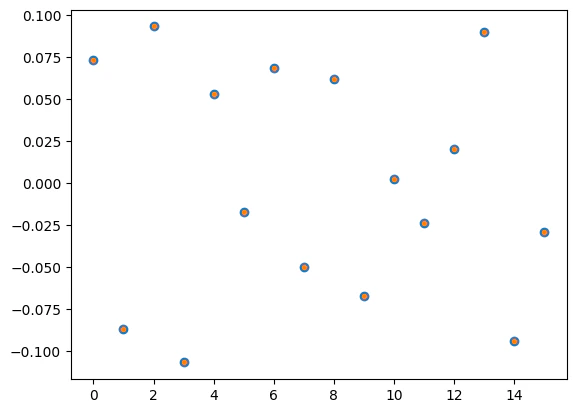
```python theme={null}
expected_sol = verify_by_plot(mat_raw_scr, rand_bvec, be_scaling_factor, qsol)
assert np.linalg.norm(qsol - expected_sol) < 1e-10
```
 #
## Banded diagonals block-encoding
```python theme={null}
# Get diagonal properties
offsets, diags, diags_maxima, prepare_norm = get_be_banded_data(mat_raw_scr)
data_size = int(np.ceil(np.log2(len(diags[0]))))
s_size = int(np.ceil(np.log2(len(offsets))))
# Calculate scaling factor and block size
block_size = s_size + 1
be_scaling_factor = prepare_norm
# Define block encoding function
@qfunc
def block_encode_banded_matrix(block: QNum, data: QNum):
block_encode_banded(
offsets=offsets, diags=diags, prep_diag=diags_maxima, block=block, data=data
)
rand_bvec = 1 - 2 * np.random.rand(2**data_size)
rand_bvec = (rand_bvec / np.linalg.norm(rand_bvec)).tolist()
qsol, qprog_banded_be = get_be_state(
rand_bvec, block_encode_banded_matrix, block_size, data_size
)
show(qprog_banded_be)
```
**Output:**
```
Quantum program link: https://platform.classiq.io/circuit/37T1AUJg5LXloVGSyrzhGapt3AC
```
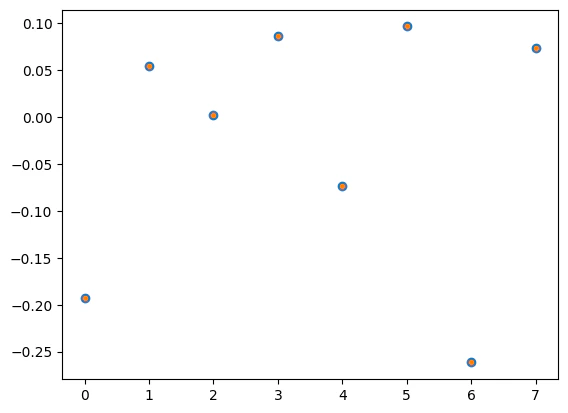
```python theme={null}
expected_sol = verify_by_plot(mat_raw_scr, rand_bvec, be_scaling_factor, qsol)
assert np.linalg.norm(qsol - expected_sol) < 1e-10
```
#
## Banded diagonals block-encoding
```python theme={null}
# Get diagonal properties
offsets, diags, diags_maxima, prepare_norm = get_be_banded_data(mat_raw_scr)
data_size = int(np.ceil(np.log2(len(diags[0]))))
s_size = int(np.ceil(np.log2(len(offsets))))
# Calculate scaling factor and block size
block_size = s_size + 1
be_scaling_factor = prepare_norm
# Define block encoding function
@qfunc
def block_encode_banded_matrix(block: QNum, data: QNum):
block_encode_banded(
offsets=offsets, diags=diags, prep_diag=diags_maxima, block=block, data=data
)
rand_bvec = 1 - 2 * np.random.rand(2**data_size)
rand_bvec = (rand_bvec / np.linalg.norm(rand_bvec)).tolist()
qsol, qprog_banded_be = get_be_state(
rand_bvec, block_encode_banded_matrix, block_size, data_size
)
show(qprog_banded_be)
```
**Output:**
```
Quantum program link: https://platform.classiq.io/circuit/37T1AUJg5LXloVGSyrzhGapt3AC
```
```python theme={null}
expected_sol = verify_by_plot(mat_raw_scr, rand_bvec, be_scaling_factor, qsol)
assert np.linalg.norm(qsol - expected_sol) < 1e-10
```
 ## Block encoding of Hermitia matrices (for LCU Chebyshev solver)
#
## Pauli block-encoding
```python theme={null}
rval = mat_raw_scr.data
col = mat_raw_scr.indices
rowstt = mat_raw_scr.indptr
nr = mat_raw_scr.shape[0]
data_size = int(np.log2(nr))
# decompose to Paulis
paulis_list, transform_matrix = initialize_paulis_from_csr(
rowstt, col, data_size, to_symmetrize=True
)
data_size += 1 # in the symmetric case the data size is increased by 1
qubit_op = eval_pauli_op(paulis_list, transform_matrix, rval)
qubit_op.compress(1e-12)
hamiltonian = of_op_to_cl_op(qubit_op)
# Calculate scaling factor and block size
be_scaling_factor = sum([np.abs(term.coefficient) for term in hamiltonian.terms])
block_size = max(1, (len(hamiltonian.terms) - 1).bit_length())
rand_bvec = 1 - 2 * np.random.rand(2**data_size)
rand_bvec = (rand_bvec / np.linalg.norm(rand_bvec)).tolist()
hamiltonian = hamiltonian * (1 / be_scaling_factor)
# Define block encoding function
@qfunc
def block_encode_pauli(block: QNum, data: QNum):
lcu_paulis_graycode(hamiltonian.terms, data, block)
qsol, qprog_pauli_sym_be = get_be_state(
rand_bvec, block_encode_pauli, block_size, data_size
)
show(qprog_pauli_sym_be)
```
**Output:**
```
Quantum program link: https://platform.classiq.io/circuit/37T1ClQiOA8YDfpBcdJe8Wyq4cY
```
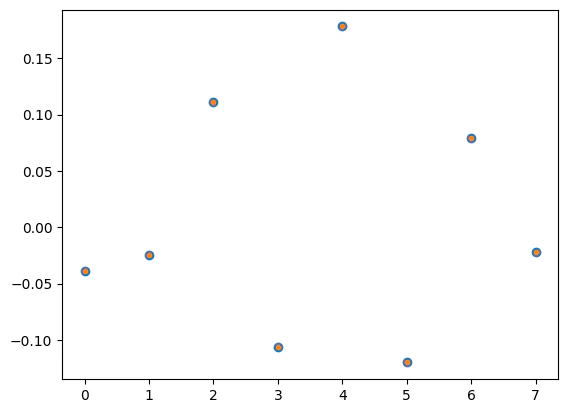
```python theme={null}
mat_raw = mat_raw_scr.toarray()
mat_sym = np.block(
[
[np.zeros([nr, nr]), np.transpose(mat_raw)],
[mat_raw, np.zeros([nr, nr])],
]
)
expected_sol = verify_by_plot(mat_sym, rand_bvec, be_scaling_factor, qsol)
assert np.linalg.norm(qsol - expected_sol) < 1e-10
```
## Block encoding of Hermitia matrices (for LCU Chebyshev solver)
#
## Pauli block-encoding
```python theme={null}
rval = mat_raw_scr.data
col = mat_raw_scr.indices
rowstt = mat_raw_scr.indptr
nr = mat_raw_scr.shape[0]
data_size = int(np.log2(nr))
# decompose to Paulis
paulis_list, transform_matrix = initialize_paulis_from_csr(
rowstt, col, data_size, to_symmetrize=True
)
data_size += 1 # in the symmetric case the data size is increased by 1
qubit_op = eval_pauli_op(paulis_list, transform_matrix, rval)
qubit_op.compress(1e-12)
hamiltonian = of_op_to_cl_op(qubit_op)
# Calculate scaling factor and block size
be_scaling_factor = sum([np.abs(term.coefficient) for term in hamiltonian.terms])
block_size = max(1, (len(hamiltonian.terms) - 1).bit_length())
rand_bvec = 1 - 2 * np.random.rand(2**data_size)
rand_bvec = (rand_bvec / np.linalg.norm(rand_bvec)).tolist()
hamiltonian = hamiltonian * (1 / be_scaling_factor)
# Define block encoding function
@qfunc
def block_encode_pauli(block: QNum, data: QNum):
lcu_paulis_graycode(hamiltonian.terms, data, block)
qsol, qprog_pauli_sym_be = get_be_state(
rand_bvec, block_encode_pauli, block_size, data_size
)
show(qprog_pauli_sym_be)
```
**Output:**
```
Quantum program link: https://platform.classiq.io/circuit/37T1ClQiOA8YDfpBcdJe8Wyq4cY
```
```python theme={null}
mat_raw = mat_raw_scr.toarray()
mat_sym = np.block(
[
[np.zeros([nr, nr]), np.transpose(mat_raw)],
[mat_raw, np.zeros([nr, nr])],
]
)
expected_sol = verify_by_plot(mat_sym, rand_bvec, be_scaling_factor, qsol)
assert np.linalg.norm(qsol - expected_sol) < 1e-10
```
 #
## Banded diagonal block-encoding
```python theme={null}
offsets, diags, diags_maxima, prepare_norm = get_be_banded_data(mat_raw_scr)
data_size = int(np.ceil(np.log2(len(diags[0])))) + 1
s_size = int(np.ceil(np.log2(len(offsets))))
# Calculate scaling factor and block size
block_size = s_size + 3
be_scaling_factor = 2 * prepare_norm
# Define block encoding function
@qfunc
def block_encode_banded_matrix(block: QNum, data: QNum):
block_encode_banded_sym(
offsets=offsets, diags=diags, prep_diag=diags_maxima, block=block, data=data
)
rand_bvec = 1 - 2 * np.random.rand(2**data_size)
rand_bvec = (rand_bvec / np.linalg.norm(rand_bvec)).tolist()
qsol, qprog_banded_sym_be = get_be_state(
rand_bvec, block_encode_banded_matrix, block_size, data_size
)
show(qprog_banded_sym_be)
```
**Output:**
```
Quantum program link: https://platform.classiq.io/circuit/37T1F9ZCWg4Jvvd8k9exfSZJv7p
```
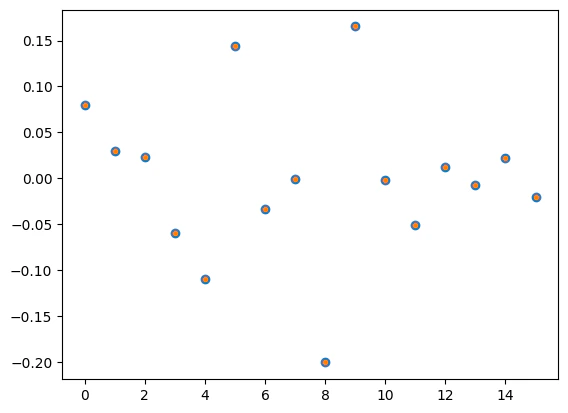
```python theme={null}
mat_raw = mat_raw_scr.toarray()
raw_size = 2 ** (data_size - 1)
mat_sym = np.block(
[
[np.zeros([raw_size, raw_size]), np.transpose(mat_raw)],
[mat_raw, np.zeros([raw_size, raw_size])],
]
)
expected_sol = verify_by_plot(mat_sym, rand_bvec, be_scaling_factor, qsol)
assert np.linalg.norm(qsol - expected_sol) < 1e-10
```
#
## Banded diagonal block-encoding
```python theme={null}
offsets, diags, diags_maxima, prepare_norm = get_be_banded_data(mat_raw_scr)
data_size = int(np.ceil(np.log2(len(diags[0])))) + 1
s_size = int(np.ceil(np.log2(len(offsets))))
# Calculate scaling factor and block size
block_size = s_size + 3
be_scaling_factor = 2 * prepare_norm
# Define block encoding function
@qfunc
def block_encode_banded_matrix(block: QNum, data: QNum):
block_encode_banded_sym(
offsets=offsets, diags=diags, prep_diag=diags_maxima, block=block, data=data
)
rand_bvec = 1 - 2 * np.random.rand(2**data_size)
rand_bvec = (rand_bvec / np.linalg.norm(rand_bvec)).tolist()
qsol, qprog_banded_sym_be = get_be_state(
rand_bvec, block_encode_banded_matrix, block_size, data_size
)
show(qprog_banded_sym_be)
```
**Output:**
```
Quantum program link: https://platform.classiq.io/circuit/37T1F9ZCWg4Jvvd8k9exfSZJv7p
```
```python theme={null}
mat_raw = mat_raw_scr.toarray()
raw_size = 2 ** (data_size - 1)
mat_sym = np.block(
[
[np.zeros([raw_size, raw_size]), np.transpose(mat_raw)],
[mat_raw, np.zeros([raw_size, raw_size])],
]
)
expected_sol = verify_by_plot(mat_sym, rand_bvec, be_scaling_factor, qsol)
assert np.linalg.norm(qsol - expected_sol) < 1e-10
```